
As we close out January 2026, the crypto market is finally waking up to a hard truth: speed (TPS) is no longer a competitive advantage. In an era dominated by autonomous agents and high-frequency PayFi, the real bottleneck is on-chain intelligence. This is exactly where @vanar has spent the last year building a fortress.
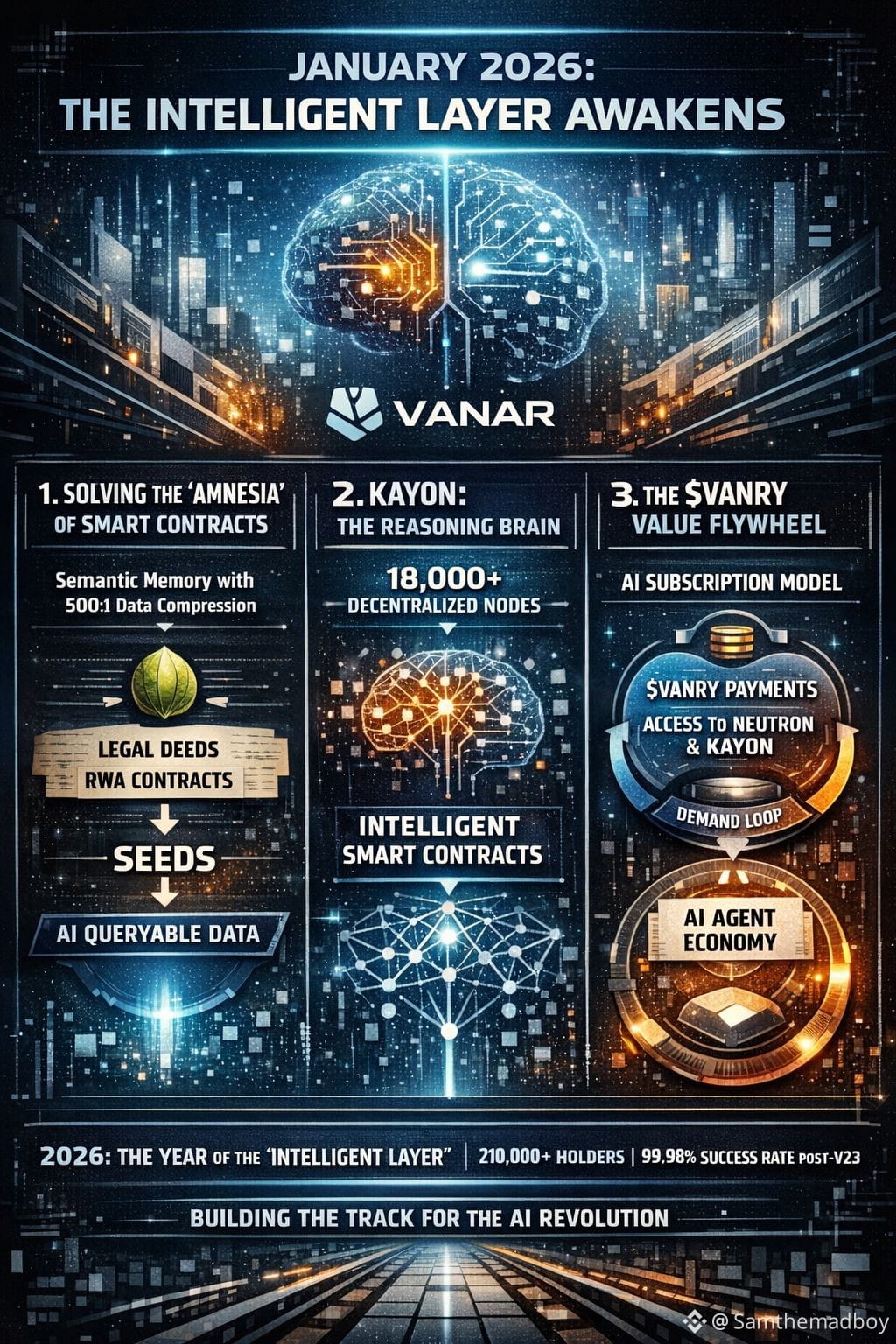
1. Solving the "Amnesia" of Smart Contracts
Traditional blockchains are "blind." They can see a transaction, but they can't understand the context of the data behind it. Through the Neutron Layer, Vanar has introduced Semantic Memory. By compressing massive datasets (like legal deeds or RWA contracts) into "Seeds" at a 500:1 ratio, Vanar allows this data to live natively on-chain. This isn't just storage; it’s queryable knowledge that AI models can use without expensive off-chain oracles.
2. Kayon: The Reasoning Brain
While other chains are just "pipes" for data, the Kayon Engine acts as the brain. This week, we saw the V23 protocol reach 18,000 active nodes, each capable of participating in decentralized reasoning. This allows $VANRY to support "Intelligent Smart Contracts" that can verify compliance, analyze player behavior in the metaverse, or trigger complex PayFi settlements autonomously.
3. The $VANRY Value Flywheel
The economic shift is real. Starting this quarter, the AI Subscription Model has gone live. Users and enterprises now pay in $VANRY to access these premium Neutron and Kayon features. This creates a fundamental demand loop that is decoupled from speculative trading. As more "AI Agents" enter the workforce, they become the primary "consumers" of Vanar gas, driving consistent network activity.
Final Thought for Day 11: If 2024 was about the "Modular" narrative, 2026 is officially the year of the "Intelligent Layer." With over 210,000 holders and a 99.98% transaction success rate post-V23, @vanar isn't just participating in the AI race—it’s providing the track.
#altcoins #crypto #BinanceSquareFamily
