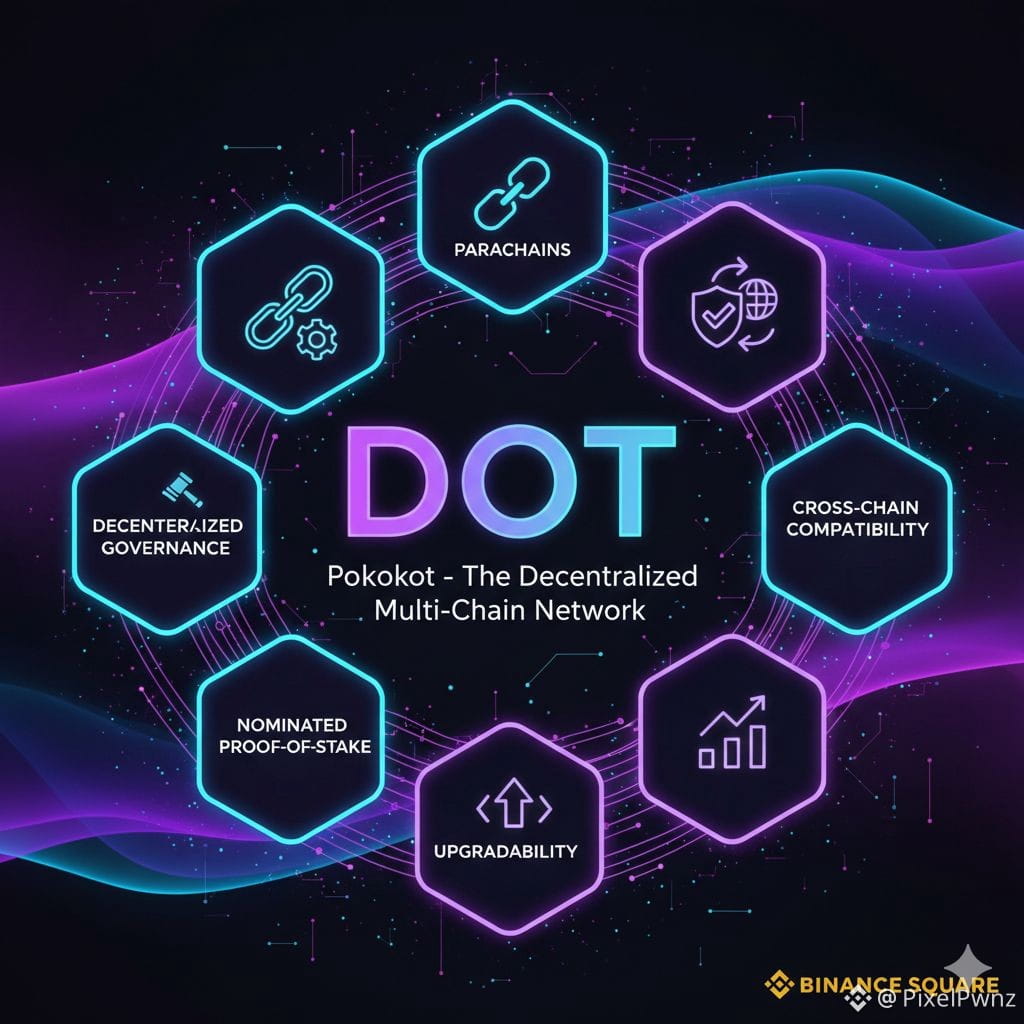
$DOT isn’t trying to be the fastest or the loudest Layer 1.
Its long-term bet is different: many specialized blockchains secured together, instead of one chain doing everything.
In a market crowded with general-purpose networks, DOT represents a modular vision — where apps get their own chains without sacrificing security.

🔍 What Is Polkadot (DOT)?
Polkadot is a multi-chain network designed around:
Shared security
Interoperability by default
Application-specific blockchains (parachains)
Instead of forcing all apps onto one chain, Polkadot allows projects to launch custom blockchains that connect to a central relay chain. DOT is used for:
Network security (staking)
Governance
Ecosystem participation
The idea is simple: optimize per use case, not per trend.
📊 Outlook Ranges (Scenario-Based)
ScenarioMarket DirectionConditionsBullishStructural recoveryAppchain growth, ecosystem tractionNeutralSideways movementStable usage, slow adoptionBearishContinued lagWeak demand, capital rotation away
These scenarios reflect sentiment paths, not price targets.
🔑 Key Drivers for DOT
🏗️ 1) Appchain (Parachain) Strategy
Polkadot focuses on depth, not simplicity. Parachains allow:
Tailored performance
Independent upgrades
Use-case-specific optimization
As crypto matures, this design may appeal more to serious builders than one-size-fits-all chains.
🛡️ 2) Shared Security Model
New chains don’t need to bootstrap validators from scratch. By connecting to Polkadot, they inherit network security — lowering barriers for:
Startups
Enterprise-style use cases
Long-term infrastructure projects
Security-sharing remains one of Polkadot’s strongest differentiators.
🔄 3) Flexible Governance & Upgrades
Polkadot emphasizes on-chain governance, allowing:
Faster protocol upgrades
Reduced reliance on hard forks
Community-driven evolution
This adaptability helps the network evolve without disruption.
🌱 4) Ecosystem Repositioning
DOT may benefit when the market rotates away from:
Short-term narratives
Meme-driven speculation
Toward:
Infrastructure
Developer-centric platforms
Long-term scalability plays
⚠️ Risks & Challenges
🧠 1) Complexity Barrier
Polkadot’s design is powerful — but complex. This can:
Slow onboarding
Confuse retail users
Limit immediate adoption
Ease of use matters in competitive markets.
📉 2) Ecosystem Visibility
Despite strong tech, Polkadot often struggles with:
Low social momentum
Limited retail excitement
Underwhelming headline growth
Perception remains a hurdle.
🔁 3) Appchain Competition
Other ecosystems now offer:
Rollups
Modular stacks
Appchain-like solutions
Polkadot must continuously prove why its model is superior.
🌍 4) Market Timing Risk
DOT performs best when markets value infrastructure and builders. In pure hype cycles, it tends to lag trend-focused assets.
📌 Quick Summary
Polkadot (DOT) is a long-game project. Its success depends less on viral narratives and more on whether app-specific blockchains become the dominant crypto architecture.
AspectSnapshotCore FocusAppchains & shared securityStrengthModular scalabilityWeaknessComplexity & visibilityAudienceBuilders & infrastructureRisk LevelMedium
📜 Disclaimer
This article is for educational purposes only and does not constitute financial advice. Cryptocurrency investments are volatile and risky. Always do your own research (DYOR).
📊 Market View: Bearish
While Polkadot’s technology is strong, current market sentiment favors simpler, narrative-driven platforms. Until ecosystem traction and visibility improve, DOT may continue to underperform relative to trend-leading sectors.