
Some projects announce a mainnet like a victory lap. Loud, celebratory, full of big promises about what comes next. Dusk’s move into mainnet territory in 2025 felt different. Quieter. More like a door closing behind years of preparation than a trumpet blast announcing the future.
Underneath that moment was something more important than launch day itself. It was the point where ideas stopped being safely theoretical. Code began carrying weight.
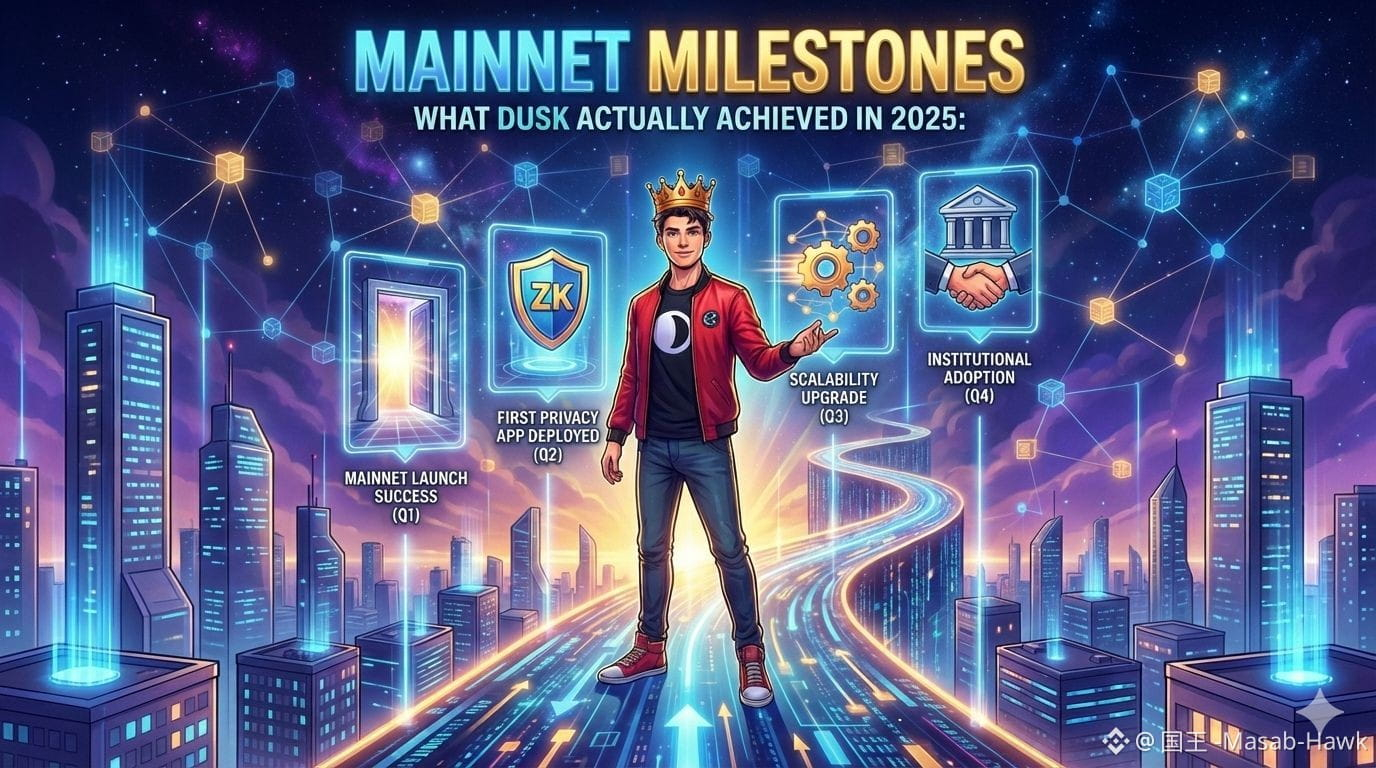
From Long Preparation to a Live Network:
Dusk didn’t rush into mainnet. That’s not marketing language, it’s just visible in the timeline. Years were spent refining cryptographic primitives, consensus mechanics, and the uncomfortable balance between privacy and regulation. By the time the mainnet went live in early 2025, most of the hard decisions had already been made.
This matters because mainnets don’t forgive shortcuts. Once assets have value and users depend on uptime, design flaws stop being academic. The first months of Dusk’s mainnet were less about new features and more about staying boring in the best way possible. Blocks finalized. Validators behaved. Nothing dramatic broke.
That steadiness, while easy to overlook, is usually earned.
Hyperstaking and the Question of Participation:
One of the first things that felt genuinely different was Hyperstaking. On the surface, it looks like another staking variant. Look longer and you notice it’s less about yield tricks and more about control.
Hyperstaking allows smart contracts themselves to stake. That small change shifts responsibility away from individuals running infrastructure and toward programmable logic. In practice, this opens room for managed staking pools, automated reward strategies, and participation models that don’t assume everyone wants to be a validator operator.
It also raises questions. Who audits these contracts? What happens when incentives inside a contract drift from network health? Early signs suggest the system works technically, but its social dynamics are still forming. Participation is easier, yes, but ease often comes with tradeoffs that only show up later.
Zedger and the Slow Reality of Asset Tokenization:
Zedger entered the picture without much noise, which is probably appropriate. Tokenizing real-world assets sounds simple until you actually try to map legal ownership, compliance rules, and settlement finality into code.
The Zedger beta in 2025 didn’t pretend to solve everything. Instead, it exposed the messy middle. How do privacy-preserving transactions coexist with auditability? How much information should counterparties see, and when? These aren’t problems you brute-force with better code.
What Zedger did achieve was a working framework that institutions could test without committing fully. That alone is meaningful. Asset tokenization doesn’t fail because the tech is missing; it fails because the surrounding systems don’t trust it yet. Zedger’s role, for now, is to earn that trust slowly.
Whether it scales beyond pilots remains to be seen.
DuskEVM and Familiar Tools in an Unfamiliar Context:
Late in 2025, Dusk introduced the public testnet for DuskEVM. This was a pragmatic move. Instead of asking developers to learn entirely new environments, Dusk leaned into what already exists.
EVM compatibility brings familiarity. Solidity, standard tooling, known patterns. But it also brings baggage. Public sequencers, challenge periods, and settlement delays mean this isn’t a copy of Ethereum with privacy sprinkled on top. Developers quickly noticed the differences.
Some appreciated the clarity. Others hesitated. Building on DuskEVM feels like working in a room that’s still being furnished. Usable, but not final. That uncertainty is part of the tradeoff. The upside is access to privacy-aware settlement underneath. The cost is patience.
If adoption grows, it will likely be because developers see value beyond convenience.
Bridges, Activity, and Fragile Momentum:
The two-way bridge connecting Dusk to external ecosystems helped activity pick up. More wallets interacted with the chain. Transactions increased. Liquidity became easier to move.
But bridges are double-edged. They bring users in and risk with them. Across crypto, bridges have been stress points, both technically and economically. Dusk’s approach leans heavily on zero-knowledge proofs to preserve confidentiality, but complexity doesn’t disappear just because it’s elegant.
So far, the bridge has done what it’s meant to do. Whether it becomes a long-term pillar or a cautious side path depends on how it holds up under sustained use.
Momentum in crypto is fragile. It often fades faster than it forms.
What the Rollout Taught the Team:
Not everything went smoothly. Documentation lagged at times. Some tools matured slower than developers hoped. Feedback loops between builders and protocol teams were sometimes uneven.
That’s normal, though it’s rarely acknowledged. Mainnet life exposes gaps that testnets hide. In Dusk’s case, one lesson stood out: privacy-focused infrastructure demands more explanation, not less. When systems intentionally obscure data, users need clearer mental models, not just stronger cryptography.
This realization showed up gradually in improved developer resources and clearer architectural communication toward the end of the year.
Market Meaning Without the Noise:
From a market perspective, 2025 didn’t turn DUSK into a headline token. And that might be fine. Token value followed usage patterns more than announcements, and circulating supply dynamics stayed predictable.
What mattered more was whether the network began to justify its existence. Mainnet uptime, staking participation, early asset experiments, and developer testing all suggested slow but real engagement.
There’s no guarantee this compounds. Many technically sound networks stall at this stage. The difference is whether builders keep showing up when incentives flatten.
Looking Ahead, Carefully:
Dusk enters its next phase without illusion. The foundation is there. The architecture is complex but intentional. Privacy, regulation, and programmability are no longer slogans but constraints the system actually lives with.
If adoption grows, it will be earned through reliability and clarity. If it doesn’t, the reasons will likely be structural rather than superficial.
For now, 2025 stands as the year Dusk stopped explaining what it wanted to be and started showing what it is. The rest is open-ended.
@Dusk $DUSK #Dusk