

When people talk about blockchains, the conversation usually becomes big and complicated very quickly. Decentralization, scalability, ecosystems, DeFi, NFTs, governance, consensus models. It sounds impressive, but if you step back and ask a very normal question — how easy is it to just send stablecoins from one person to another — the answer is often surprisingly messy.
That small moment, pressing the “send” button for USDT or any stablecoin, still comes with friction. You check the network. You check the gas. You realize you don’t even have the native token to pay the fee. You swap. You retry. You wait. For something that is supposed to feel like digital cash, it still feels like you are operating a machine built for engineers.
Plasma looks at this exact frustration and builds from there. Not from the idea of becoming the biggest ecosystem. Not from trying to host every possible use case. But from a very narrow and very practical thought: stablecoins are already acting like money, so they deserve infrastructure that treats them like the main purpose, not a side feature.
This is where the philosophy behind XPL begins to make sense. Plasma is not trying to be a loud blockchain. It is trying to be a quiet one. A chain that does its job so smoothly that users stop noticing the chain entirely.
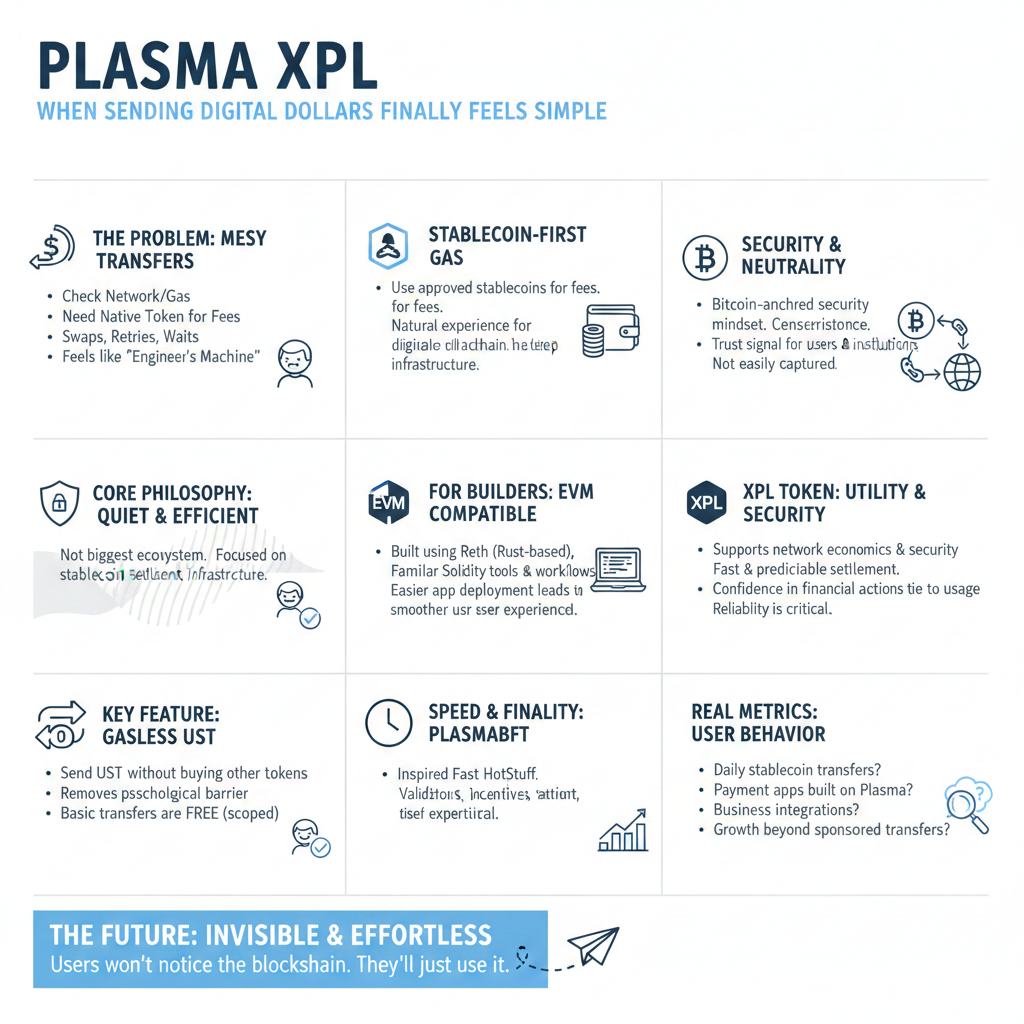
The core design of Plasma revolves around stablecoin settlement. That means the chain is engineered around how stablecoins move, how often they move, and how humans interact with them. One of the most talked about parts of this design is gasless USDT transfers. In simple words, a user can send USDT without first buying another token just to pay network fees. That single change removes a psychological barrier that stops many people from using stablecoins comfortably. Plasma does not claim everything is free forever. The system is scoped carefully, and more complex actions still involve fees, but the most common human action — sending stablecoins — is treated as a first-class experience.
Beyond simple transfers, Plasma introduces the idea of stablecoin-first gas. Instead of forcing every user to hold the native token before doing anything, the network architecture allows approved stablecoins to be used for fees through protocol-level design. This makes the entire experience feel natural for people who only want to hold and use digital dollars without learning the deeper mechanics of blockchain tokens.
Under the hood, Plasma is fully EVM compatible and built using Reth, the Rust-based Ethereum execution client. This decision is less visible to users but extremely important for builders. Developers can use familiar Solidity tools and Ethereum workflows, which lowers the barrier for creating applications that run on Plasma. When builders find it easy to deploy, users eventually feel that ease through better apps and smoother integrations.
Speed and finality are another part of the story. PlasmaBFT, inspired by the Fast HotStuff family, is designed to make settlement feel fast and predictable. Payments do not tolerate uncertainty. When someone sends money, they want confidence that it is final. Plasma’s consensus design focuses on that feeling of reliability, which is critical for anything that wants to behave like financial infrastructure.
There is also a strong emphasis on neutrality through a Bitcoin-anchored security mindset. Plasma’s approach to bridging Bitcoin into its environment is meant to add credibility and resistance to censorship. For a settlement chain, neutrality is not just a technical feature. It is a trust signal. It tells users and institutions that the network is not easily captured or controlled.
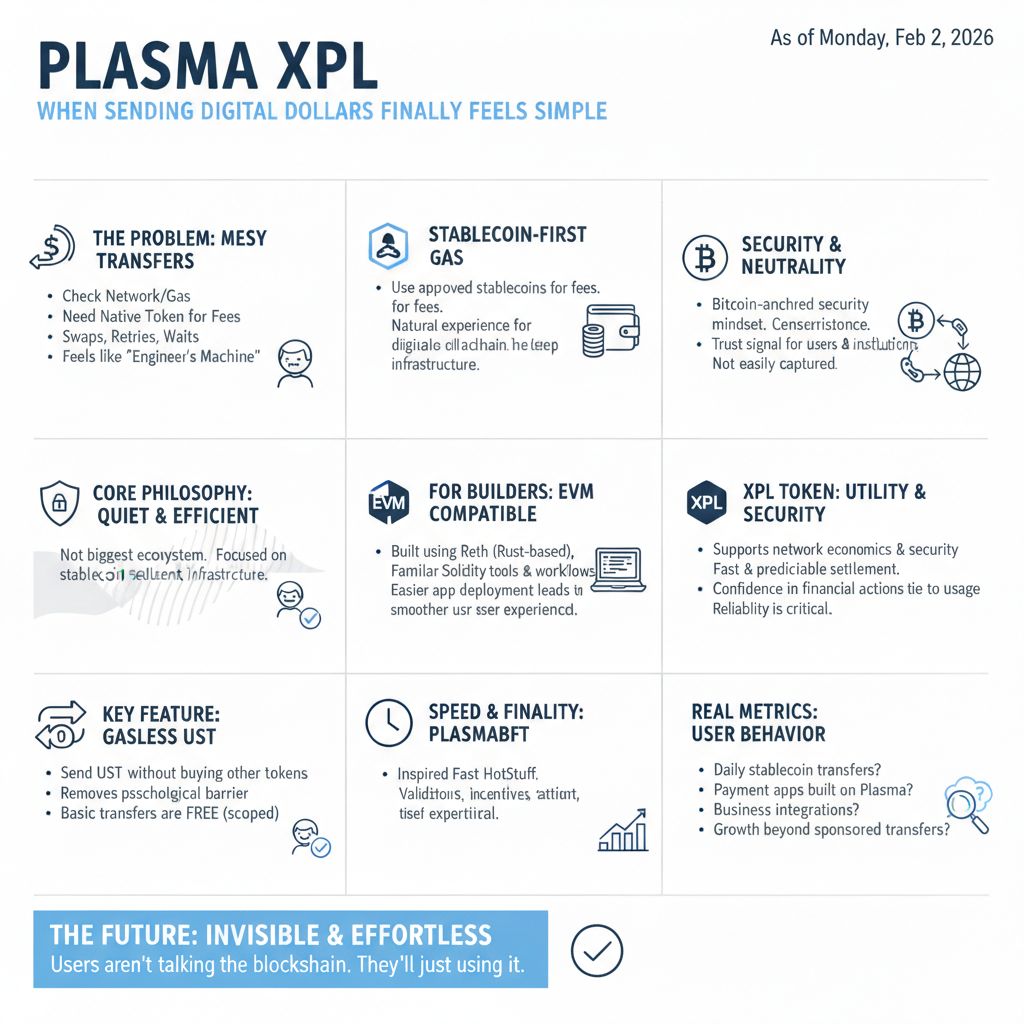
This is where XPL fits naturally into the picture. XPL is not presented as a token for hype. It supports the economics and security of the network. Validators, incentives, and sustainability all depend on it. While some transfers can be gasless, a real blockchain cannot survive on “free” forever. Activity beyond basic transfers generates fees that flow through the system, tying the token to actual network usage.
If you want to understand Plasma and XPL seriously, the real signals are not in marketing posts but in behavior. Are users sending stablecoins daily because it feels easier? Are applications being built that rely on Plasma for payments? Are businesses integrating it because it reduces friction? Is usage growing in areas beyond sponsored transfers? These are the signs that matter.
Recent developments around mainnet progress, documentation releases, and technical explanations show that Plasma is actively clarifying how its system works rather than hiding behind vague claims. Features like zero-fee transfers and custom gas tokens are still evolving, which is important to acknowledge because it highlights where execution is still in progress.
Plasma’s role in the blockchain landscape is simple but powerful. It is not trying to be everything. It is trying to be the place where stablecoin movement feels natural, invisible, and effortless. If it succeeds, users will not talk about Plasma the way they talk about other chains. They will simply use it without thinking.
And in the world of payments, that is the highest compliment a system can receive.
Plasma XPL is building toward a future where sending digital dollars feels as normal as sending a message, and the true value will be proven when people stop noticing the blockchain behind it.