
Most discussions about AI infrastructure still begin at the wrong layer.
They focus on intelligence, models, or how autonomous a system appears in a controlled setting. After watching many systems move from experimentation into continuous operation, I have learned that intelligence is rarely the point of failure.
The real constraint shows up later, when nobody is watching.
A system only becomes meaningful once it is expected to run without supervision. At that stage, the problem is no longer decision making. It is whether those decisions can reliably turn into final outcomes, every time, without exception.
This is where most AI driven systems quietly fail.
Settlement is where the friction concentrates.
Early on, settlement uncertainty looks manageable. A delayed confirmation, a retry loop, a fallback condition. Humans tolerate this easily. We refresh dashboards, wait, or step in when something stalls. Automated systems do not have that option. Every uncertainty forces branching logic. Every branch increases complexity.
Over time, the system becomes harder to operate than the problem it was meant to solve.
Vanar makes sense to me because it starts from this operational reality. Its design assumes machines will act continuously and without supervision. That assumption immediately limits what the infrastructure can afford to be vague about.
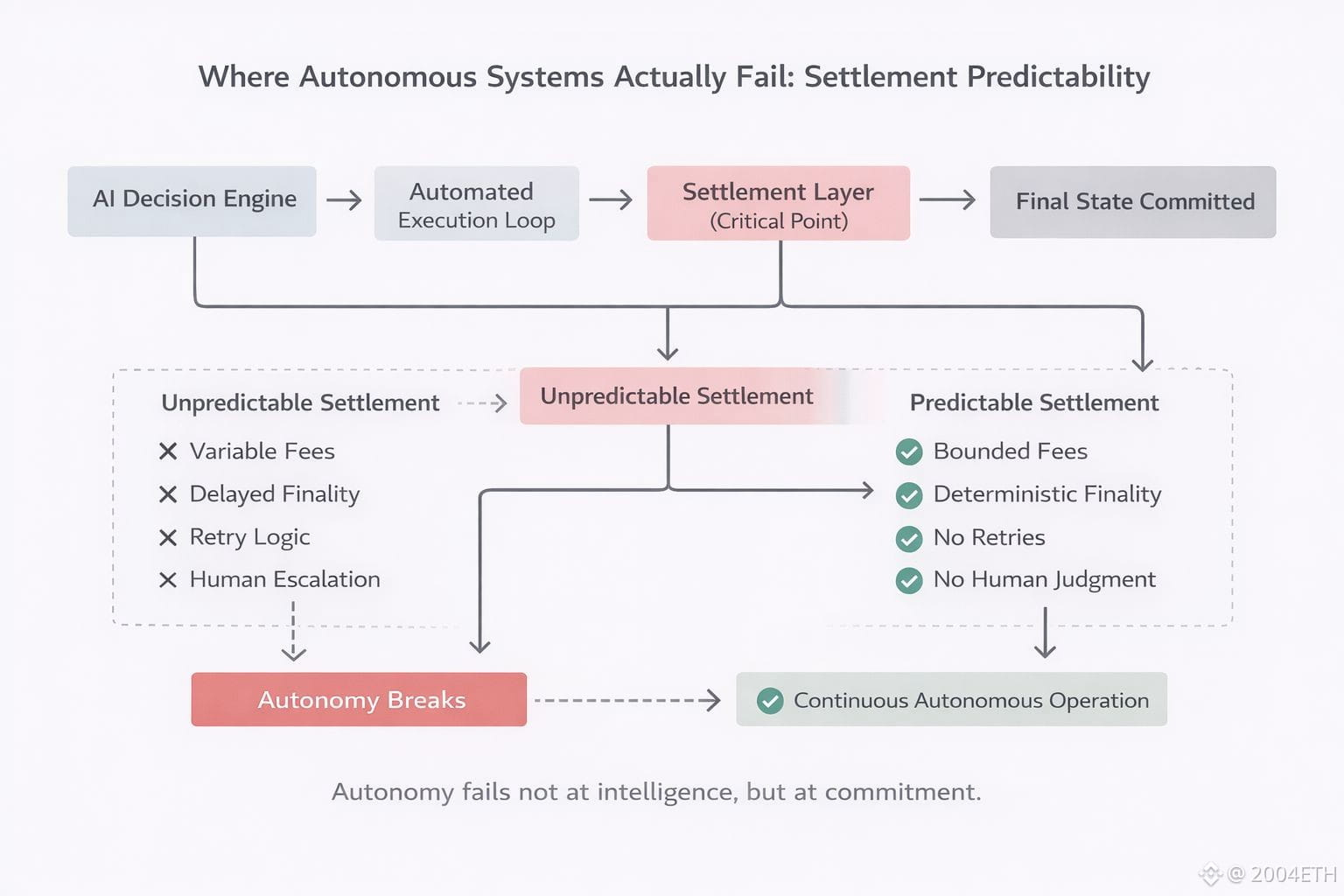
Settlement cannot be probabilistic. It cannot be something that usually works. It has to be predictable enough to sit inside the execution loop itself.
This is not a fashionable design choice.
Predictability reduces flexibility. It narrows optionality. It limits how much behavior can be adjusted on the fly. Vanar accepts that trade off deliberately, choosing tighter constraints so automated systems do not need to constantly re evaluate their environment.
From an operator perspective, this matters more than raw capability.
I have seen systems with impressive feature sets collapse under their own optionality. Too many edge cases. Too many moments where someone needs to decide what should happen next. Each of those decisions re introduces human judgment into a system that was supposed to remove it.
Vanar pushes that judgment down into the infrastructure layer.
Instead of asking agents to adapt to changing execution conditions, it enforces conditions that agents can assume. Logic becomes simpler. Monitoring becomes lighter. Failure handling becomes deterministic rather than procedural.
This also changes how value movement is treated.
Settlement is not an external service that execution depends on. It is part of execution itself. An action is not complete until value movement is final and observable by the rest of the system. That shared assumption allows independent agents to coordinate without constant communication.
The hidden cost of autonomy lives here.
It does not show up in transaction fees. It shows up in retries, alerts, escalation paths, and human oversight. Each layer exists to compensate for uncertainty. When settlement becomes predictable, many of those layers disappear entirely.
VANRY’s role becomes clearer through this lens.
It is not designed to incentivize clicks or speculative activity. It underpins participation in a system where value movement is expected to occur as part of automated processes. The token sits inside execution, not at the edge of user behavior.
This only works if settlement is reliable enough to be assumed rather than negotiated.
What I find compelling is that Vanar does not optimize for attention. It optimizes for endurance. Systems that are meant to stay running. Systems that do not pause. Systems that cannot wait for someone to notice something went wrong.
There is a tendency to think autonomy exists on a spectrum.
In production, it does not. Either a system can run without intervention, or it eventually drifts back toward manual control, no matter how advanced it looks on paper.
Vanar feels built with that binary reality in mind.
It does not promise that failures will not happen. It assumes they will. The difference is that failure is expected to resolve deterministically, without negotiation or interpretation.
That assumption reshapes everything.
Over time, fewer assumptions mean less complexity. Less complexity means lower operational cost. The system becomes quieter, not because nothing is happening, but because fewer things demand attention.
Vanar is not infrastructure for demos.
It is infrastructure for systems that are expected to keep running.
For long running AI systems, flexibility is attractive early on. Predictability is what keeps them alive later.