
Dusk was founded in 2018, at a moment when the blockchain world was racing forward with breathtaking confidence and very little self-doubt. Transparency was treated like a moral absolute. If everything could be seen, the thinking went, then everything would be fair. But for many people watching from the edges—workers, small institutions, families, regulated financial actors—this vision felt less like freedom and more like exposure. The question that gave birth to Dusk was not technical. It was emotional: what does it cost a person when their financial life is never allowed to be private again?
Dusk did not emerge as a rebellion against regulation or institutions. It emerged from empathy. Finance has always carried intimacy. Salaries reveal power dynamics. Contracts reveal strategy. Savings reveal fear, hope, and survival. Long before cryptography, societies learned that money must be handled with discretion because people are vulnerable without it. Dusk was built on the belief that digital finance should inherit that wisdom, not discard it.
Early blockchains forced an impossible trade-off: participate, but surrender your visibility forever. Dusk refused that bargain. It treated privacy not as a shield for wrongdoing, but as a form of respect. In its design, transactions can remain confidential while still being provably correct. Smart contracts can function without exposing sensitive details, yet still produce cryptographic proof that rules were followed. Nothing is hidden from truth—only from unnecessary exposure.
This balance between privacy and accountability is where Dusk feels deeply human. People do not live transparently at all times. We share selectively, with intention, with those who have the right to know. Doctors protect our medical records while still answering to regulators. Lawyers guard client confidentiality while remaining officers of the court. Dusk encodes this same social instinct into financial infrastructure, allowing systems to verify honesty without demanding emotional nakedness.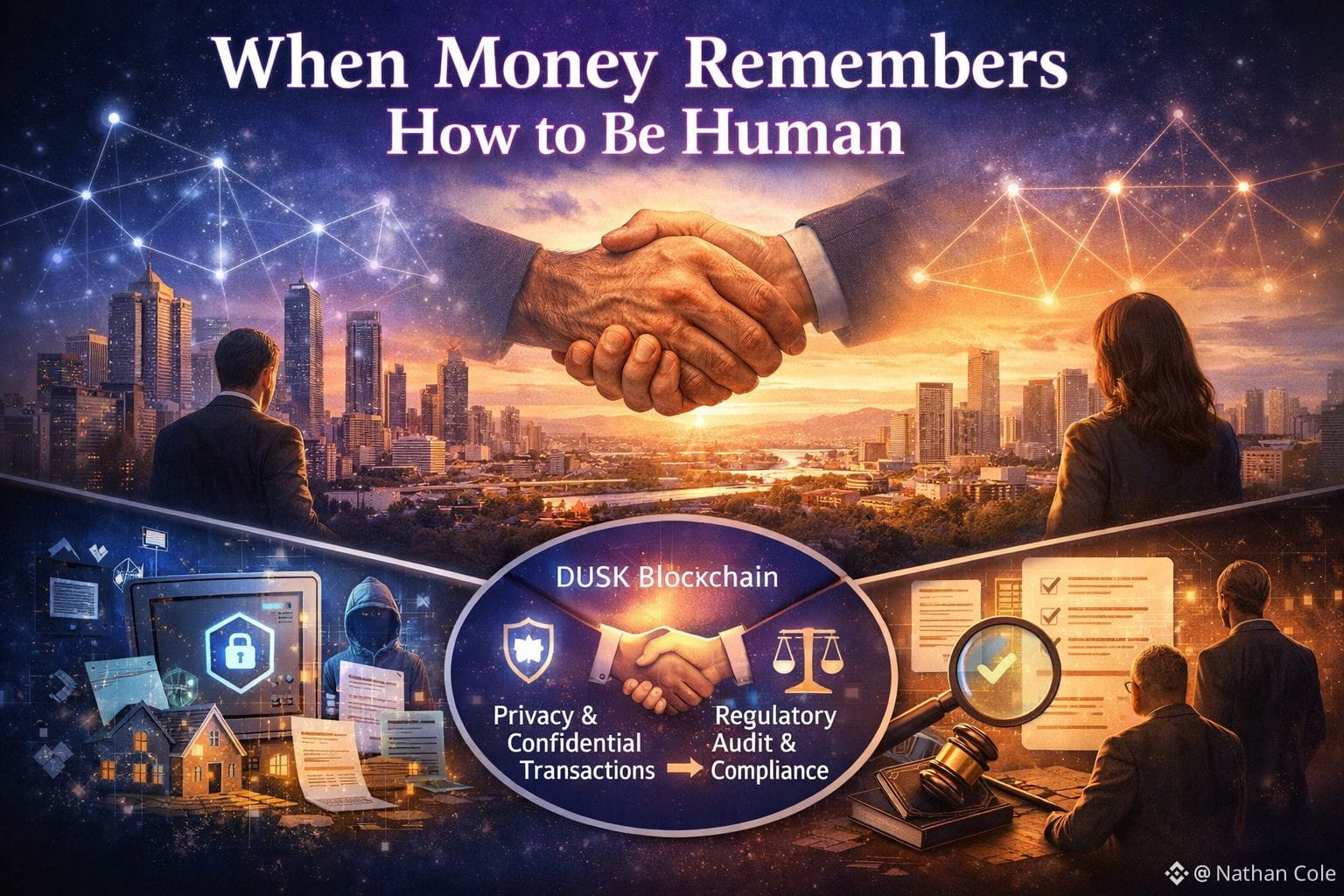
The architecture itself reflects restraint. Modular, adaptable, and designed for longevity, it acknowledges that finance does not exist in a vacuum. Laws evolve. Institutions move carefully. Trust takes time. Rather than chasing spectacle, Dusk prepares for reality. It accepts that meaningful adoption requires patience, compliance, and proof—not slogans.
The DUSK token follows the same philosophy. It exists to secure the network, align incentives, and reward long-term participation, not to promise instant enrichment. In a market often driven by urgency and speculation, this grounded approach stands out. It asks participants to care, to commit, to think beyond the next cycle.
Where Dusk’s emotional weight truly settles is in its focus on real-world finance. Tokenized assets are not just digital abstractions—they represent homes, retirements, labor, and legal obligations. When these are exposed recklessly, power concentrates and vulnerability grows. When they are handled with privacy and auditability, access can widen without sacrificing safety. Dusk chooses care over convenience.
Its openness—through documentation, reports, and public accountability—reinforces this choice. Transparency here is intentional, not invasive. It is the transparency of governance, not surveillance. The kind that builds trust rather than fear.
At its core, Dusk is not trying to reinvent money. It is trying to remember what money has always been tied to: human dignity. It acknowledges that finance carries anxiety as much as ambition, survival as much as profit. By designing systems that protect privacy while honoring responsibility, Dusk offers a quieter, more mature vision of what blockchain can become.
This is not the story of disruption for disruption’s sake. It is the story of choosing the harder path because it is the kinder one. Of building technology that bends toward people instead of asking people to bend toward it.
Dusk exists because honesty does not require exposure, because trust does not require surveillance, and because the future of finance—if it is to be worth building at all—must remember how to be human.
