
I still remember the first time I tried fitting #Plasma into a deployment flow I know by muscle memory. What made me pause wasn’t a promise of TPS or a marketing chart, but the odd feeling that everything had less friction. Honestly, after a few cycles worn down by mainnets that felt like coin flips, I’ve grown suspicious of anything that sounds too smooth.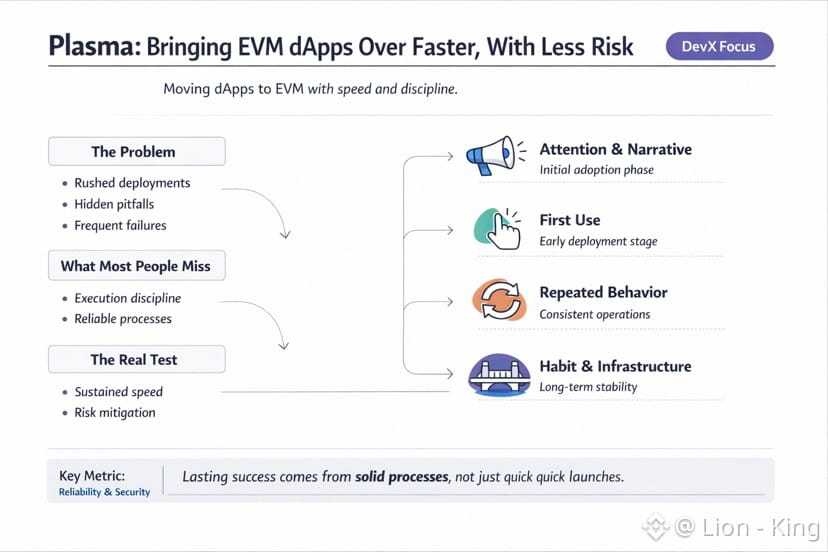
Plasma is framed around a fairly straightforward ambition: move EVM dApps over faster, with less risk. It sounds like a tagline, but I look at the path, not the destination. In crypto, speed often comes with technical debt, and “less risk” is often just a fresh coat of paint, because the real risk sits where nobody talks about it, inside process, discipline, and how a team protects itself from repeating the same failures. Maybe what’s interesting about Plasma is that it treats DevX as something that can compound over time, instead of tooling being an afterthought added for appearances.
I think people have gotten too used to judging an ecosystem by the number of projects and TVL, then forgetting that most projects die from bad execution, not from a lack of ideas. With Plasma, if DevX truly becomes the “product layer,” the question stops being how fast you can ship, and becomes how long you can ship fast without shooting yourself in the foot. A coherent toolchain for testing, deployments, observability, and upgrades reduces friction for teams, especially teams without deep infra benches. Ironically, what creates the real edge is often not a flashy feature, but fewer “slip ups” that turn into incidents, and fewer nights spent awake just to patch mistakes that came from loose process.
But I’m not naive. “Moving over fast” in the EVM world isn’t just about bytecode compatibility or contracts running, it’s about how the system behaves under load, and whether the surrounding tools are reliable enough. Bridges, deployment ordering, upgrade mechanisms, monitoring, rollback, all of it is where risk hides. Nobody expects a project to fail because of one wrong config or a rushed deployment script, but I’ve seen it too many times. So if Plasma wants to claim “less risk,” I’ll look at whether they make common failures harder to happen, and when they do happen, whether the blast radius is contained.
There’s another thing I always watch, which is how an ecosystem handles upgrades. Upgrades aren’t sexy, they don’t pull views, but they reveal the nature of a builder team. When tooling and upgrade processes are designed well, builders fear change less, and users are less likely to become test subjects. Or put differently, Plasma will only be “fast” in a sustainable sense if it creates standards for disciplined upgrades, with verification, observability, and the ability to respond, rather than chasing speed for the sake of storytelling. I think this is where DevX becomes a real competitive advantage, because it shapes the development cadence of an entire community, from code and docs to operational conventions.
Of course, I still pay attention to economics and incentives, even if I don’t want to get lost in tokenomics today. Because in the end, great tooling that doesn’t keep builders around, or doesn’t help them create products with real users, is still just a loop of pretty demos. But if Plasma gets it right, the value shows up quietly: fewer incidents, less downtime, less drama, and more time for teams to focus on user experience. Honestly, in a market that rewards noise, I trust things measured in hours saved and errors avoided, even if they don’t spark hype overnight.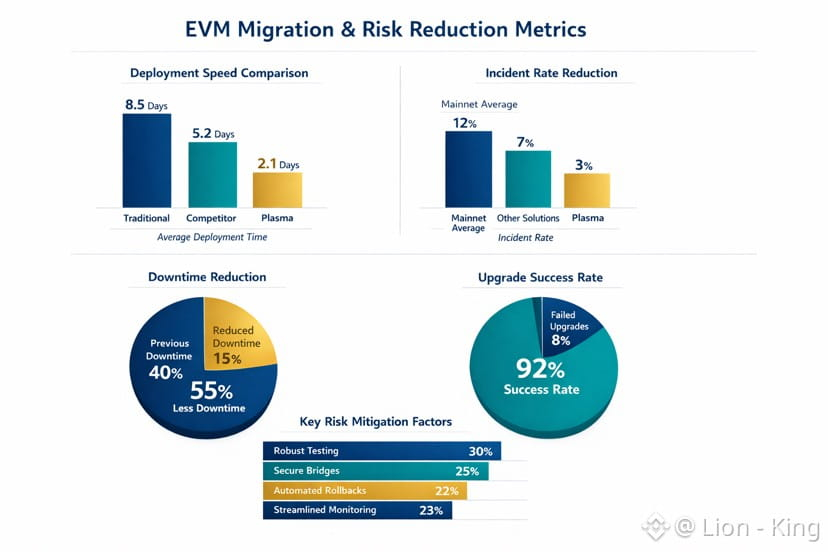
The biggest lesson Plasma has offered me so far is that a project doesn’t need to say it’s “safe” or “fast” in a confident voice, it needs to prove it through system discipline. Maybe I’m tired because I’ve watched too many projects promise speed while neglecting process, then get swallowed by their own velocity. If Plasma keeps DevX as the foundation, and turns “low risk shipping” into a habit of the ecosystem instead of a slogan, it has a chance to last longer than market moods. The question is, when the shine fades, will Plasma still have the discipline to stay fast while staying low risk. @Plasma $XPL

