
Walrus (WAL) is rapidly emerging as a critical infrastructure project in the Web3 ecosystem, addressing one of the most pressing challenges faced by decentralized networks: secure, efficient, and verifiable storage of large-scale data. In traditional blockchain networks, storing significant amounts of data directly on-chain is neither practical nor cost-effective. This limitation has historically forced decentralized applications (dApps) to rely on centralized storage solutions, introducing vulnerabilities such as single points of failure, censorship risks, and trust assumptions. Walrus seeks to fundamentally shift this paradigm by providing a decentralized storage solution that is highly scalable, economically sustainable, and deeply integrated with the Sui blockchain.
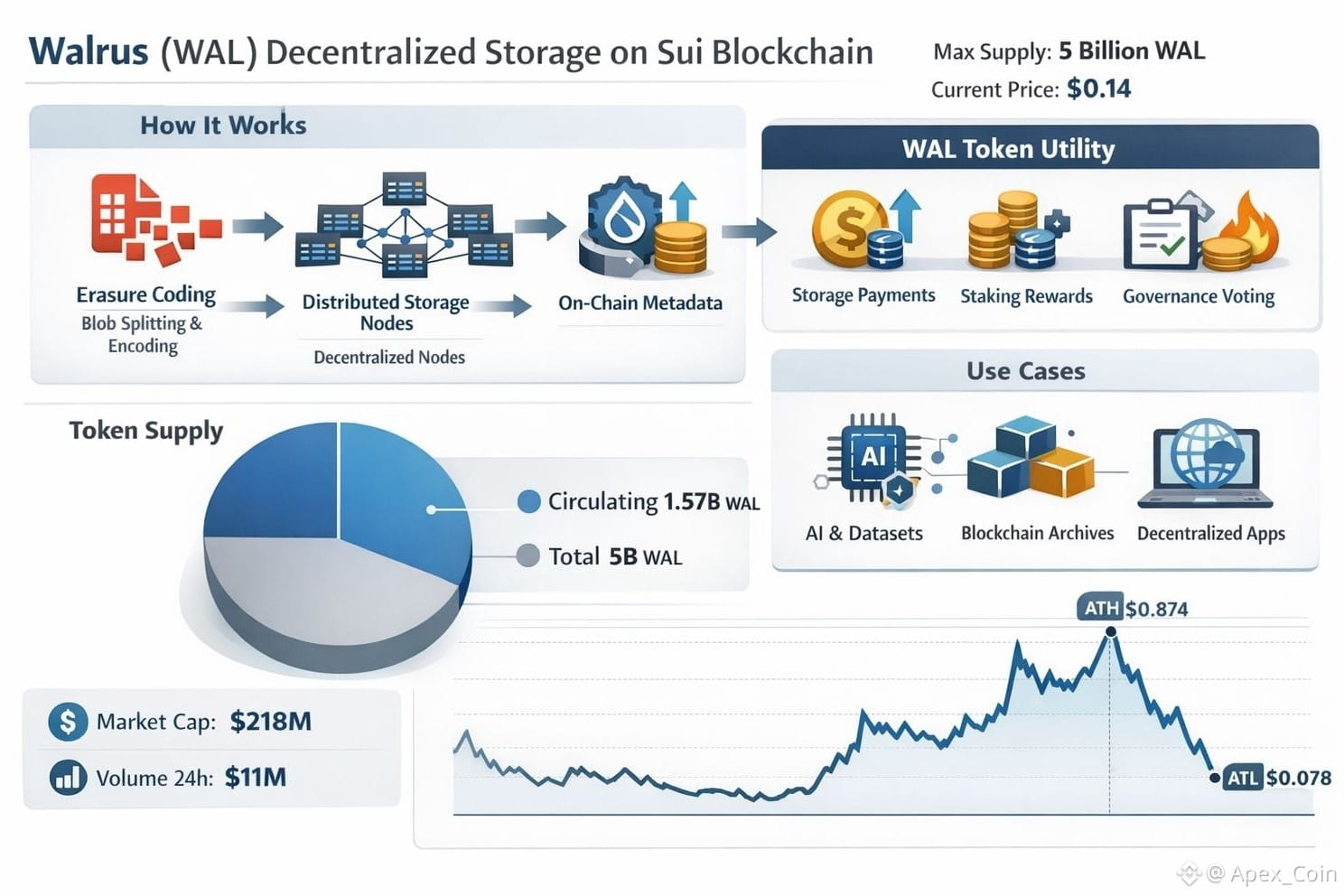
At its core, Walrus is a decentralized storage and data availability protocol built to handle “blobs” of data large files such as videos, images, NFT metadata, AI datasets, blockchain archives, and application states. The system is designed to store these large files across a network of independent storage nodes, while only storing lightweight metadata and availability proofs on-chain. This architectural decision leverages the strengths of the blockchain for verifiability and coordination while offloading the heavy data storage to a decentralized network. This hybrid approach allows developers to achieve scalability without compromising on security or decentralization.
One of the foundational innovations behind Walrus is its use of advanced erasure coding, commonly referred to in the ecosystem as “Red Stuff.” When a user uploads a file, it is split into multiple fragments, encoded, and distributed across numerous storage nodes. This process ensures that the original file can be reconstructed even if a significant portion of the nodes goes offline. By using this approach, Walrus achieves fault tolerance and redundancy more efficiently than simple replication methods, minimizing storage overhead and improving overall system resilience.
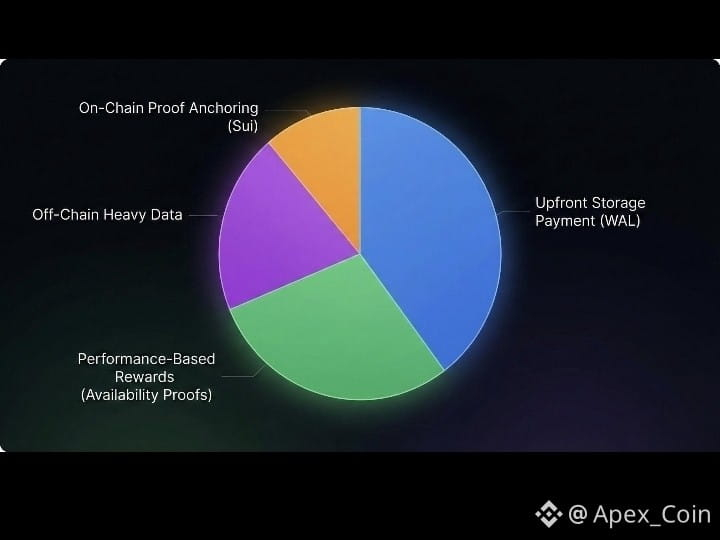
Storage nodes in the Walrus network are independent operators who commit disk space and bandwidth to host fragments of the data. To ensure reliability and honest behavior, nodes must stake $WAL tokens, the protocol’s native utility token. Staked tokens serve as collateral and provide economic incentives: operators who maintain high availability and performance earn rewards, while misbehaving nodes face penalties or slashing events. This model aligns the economic interests of network participants with the health and security of the storage network.
The Wal token is integral to the functioning of the protocol. Beyond staking, it is used to pay for storage services, enabling users to rent space on the network. Token holders can also delegate their WAL to trusted operators, earning a portion of rewards while participating indirectly in network security. Governance is another key function of WAL. Token holders can vote on critical protocol parameters, including fee structures, slashing conditions, storage pricing, and protocol upgrades, ensuring that control over the network is distributed across its community rather than concentrated among a small team.
Developer experience is a major focus for Walrus. The protocol provides extensive tooling, including command-line interfaces (CLIs), software development kits (SDKs), and application programming interfaces (APIs), allowing developers to integrate decentralized storage into their applications with minimal friction. By offering easy-to-use tools, Walrus reduces the barrier to adoption, enabling developers to focus on building innovative dApps rather than managing storage infrastructure. This approach has particular significance for applications in AI, gaming, NFT platforms, decentralized websites, and blockchain archiving, all of which require reliable access to large datasets.
Security and censorship resistance are foundational to Walrus. Because data is distributed across multiple independent nodes, no single entity can easily remove or tamper with stored content. Furthermore, cryptographic proofs and on-chain metadata enable users to verify that data is stored correctly and remains accessible over time. This verifiability provides transparency and builds trust in the system, addressing a critical concern for both developers and end-users in decentralized ecosystems.
Walrus also emphasizes cost-efficiency. Traditional decentralized storage networks often suffer from high fees or complex pricing models, discouraging widespread adoption. By leveraging erasure coding and a distributed network of storage nodes, Walrus can offer competitive pricing while maintaining high availability and redundancy. Users benefit from a predictable, economically sustainable system for storing large files, without sacrificing the security and decentralization inherent in blockchain-based solutions.
The choice of Sui blockchain as the underlying layer-1 platform is strategic. Sui’s parallel execution model and object-centric design allow Walrus to handle high volumes of coordination transactions efficiently. This includes tracking metadata, verifying availability proofs, managing staking and rewards, and supporting governance processes. By leveraging Sui’s high throughput and low-latency capabilities, Walrus ensures that its decentralized storage network operates efficiently and reliably even as usage scales.
The economic design of $WAL tokens is carefully crafted to support network sustainability. The total supply is capped at 5 billion WAL, with allocations distributed among ecosystem incentives, development teams, early contributors, and community rewards. Transaction fees and storage payments in WAL flow back into the system, funding node rewards and, in some cases, reducing circulating supply through burns or other deflationary mechanisms. This design creates a feedback loop: as real network usage grows, demand for WAL tokens increases, aligning the token’s economic value with the success of the storage network.
In terms of adoption, Walrus has been gaining traction among developers who require decentralized, verifiable, and reliable storage. For NFT projects, the ability to store rich media content in a decentralized and censorship-resistant manner is invaluable. AI developers can rely on Walrus to host large datasets and model artifacts, ensuring integrity and reproducibility. Blockchain projects can use Walrus to archive historical data, reducing on-chain storage bloat while maintaining accessibility and verifiability. Additionally, decentralized websites and Web3 applications can leverage Walrus to store static assets, creating fully decentralized user experiences.
Comparatively, Walrus differentiates itself from legacy decentralized storage networks by emphasizing developer experience, performance, and integration with a modern layer-1 blockchain. While platforms like Filecoin or Arweave provide decentralized storage, they often involve complex onboarding processes and lack tight integration with a fast, high-throughput blockchain. Walrus bridges this gap, offering a seamless combination of on-chain coordination, off-chain storage, and developer-friendly tools, positioning it as a practical choice for next-generation Web3 applications.
The protocol’s roadmap highlights ongoing improvements to optimize storage efficiency, reduce latency, and enhance access control features. Support for smaller files, improved APIs, SDK updates, and deeper integration with the Sui ecosystem are all in development. These enhancements aim to make Walrus an invisible yet reliable infrastructure layer, allowing developers and end-users to focus on application functionality rather than storage logistics.
From a broader perspective, decentralized storage solutions like Walrus are becoming increasingly vital as data-intensive applications, AI platforms, and Web3 services proliferate. The demand for verifiable, censorship-resistant, and scalable storage is only set to grow. By providing a reliable, economically sustainable, and developer-friendly solution, Walrus positions itself as a core infrastructure layer for the next generation of decentralized applications, contributing to the maturation of the Web3 ecosystem.
In conclusion, Walrus (WAL) is more than just a decentralized storage protocol; it is a foundational component of the emerging Web3 infrastructure. By combining Sui blockchain’s performance, advanced erasure coding, a well-aligned token economy, and developer-centric tools, Walrus addresses one of the most critical challenges in decentralized networks: storing and verifying large-scale data securely, efficiently, and economically. Its combination of technical innovation, economic design, and practical usability makes it an essential layer for developers, token holders, and the broader decentralized ecosystem, supporting the next wave of blockchain-native applications, NFTs, AI datasets, and
decentralized web services.