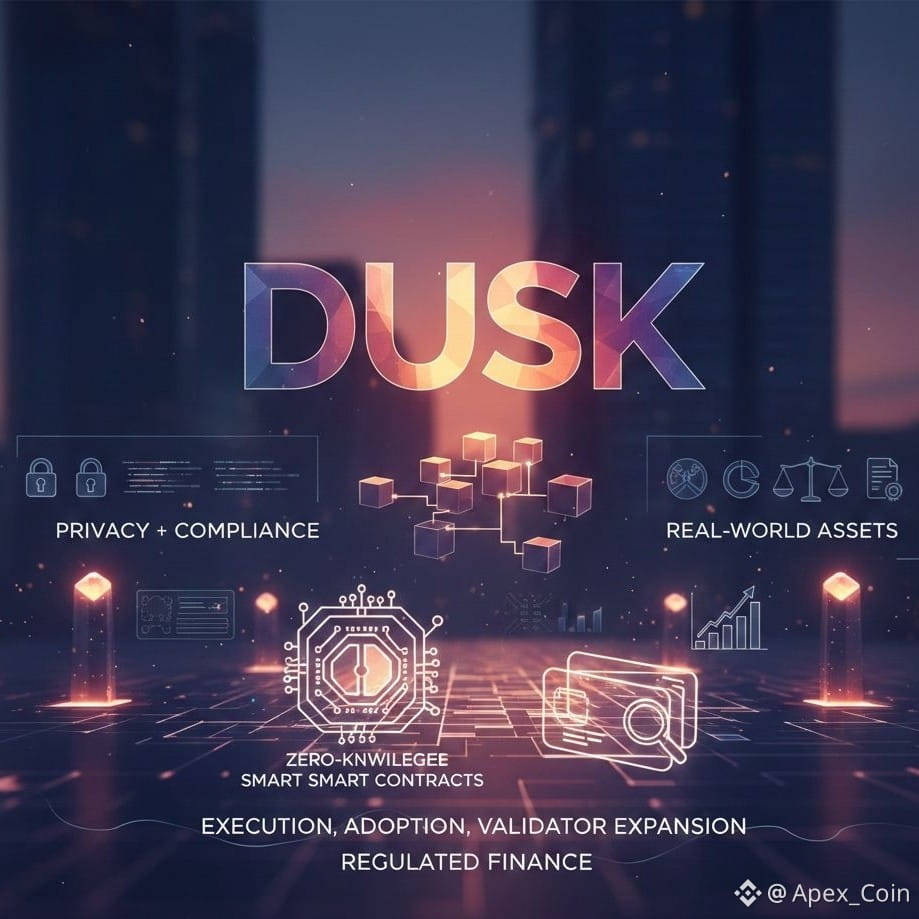
That single distinction explains almost everything about it.While the crypto market obsesses over speed, fees, and short‑term attention, Dusk focuses on a quieter but far more difficult question:
How do you move real financial activity on‑chain without breaking the rules that finance already operates under?This is not a theoretical problem. It is the main reason banks, funds, and issuers still hesitate to use public blockchains.
Public blockchains are transparent by default.That transparency is powerful — but in finance, it is also dangerous.
No serious institution can operate if:
• Trade sizes are public
• Counterparties are visible
• Strategies can be copied
• Client positions are exposed
What works for retail speculation does not work for regulated markets.Dusk starts from this reality instead of ignoring it.
The philosophy behind $DUSK is simple:
Privacy is not about hiding wrongdoing.Privacy is about enabling lawful activity.On Dusk, confidentiality exists where it is needed, and verification exists where it is required.Transactions do not need to be public to be correct.Balances do not need to be visible to be legitimate.
Compliance does not need exposure to be enforced.Instead of revealing data, Dusk relies on cryptographic proofs to show that rules were followed.This approach allows markets to function without turning sensitive information into public content.
Where many blockchains talk about “real‑world assets,” Dusk actually designs for them.Real assets come with conditions:
• Who can own them
• Who can trade them
• Under which jurisdiction
• With what reporting obligations
@Dusk does not treat these as external problems.
They are embedded into how assets behave on-chain.This makes Dusk suitable for:
• Tokenized securities
• Bonds and funds
• Regulated financial products
• Institutional settlement flows
Not everything should be permissionless.
Dusk accepts that.Another key difference is architecture.Dusk does not try to compress everything into one rigid system.
Execution, settlement, privacy, and compliance are separated into distinct components. This modular design allows the network to adapt as regulations and market requirements change.
In finance, adaptability is not optional.Dusk also supports familiar development environments.
Smart contracts can be written using known tools, but they operate within a very different context. Access rules, privacy constraints, and compliance logic are part of the execution environment.The result is decentralized finance that feels closer to real finance.
Less chaos.More structure.Identity is another area where Dusk takes a balanced approach.Participants can prove eligibility without publicly revealing who they are. Institutions can onboard users without exposing sensitive information to the entire network.
Identity becomes functional, not invasive.Dusk is not optimized for viral growth.
Its adoption curve is slow by design. Institutions move carefully. Integration takes time. Legal clarity matters.
But once systems are in place, they tend to last.Infrastructure grows quietly then suddenly becomes essential.
This is why Dusk rarely fits into short‑term narratives.It does not promise instant liquidity.
It does not chase retail hype.
It does not market speculation.What it offers instead is something harder to sell, but more durable:
A blockchain that can survive regulation instead of fighting it.
Final thought.Crypto does not replace finance by ignoring its rules.
It replaces finance by improving how those rules are executed.
Dusk understands that.And that understanding is what makes it different.