
There is a moment most people never talk about—the moment you feel technology has left you behind. When screens get smarter but life doesn’t get easier. When innovation accelerates, yet meaning thins out. Vanar seems to begin exactly at that moment, not with ambition, but with empathy. It feels like a project born from listening to disappointment, from watching people be promised futures that never arrived, and deciding—quietly—to try again, but differently.
Vanar is not trying to impress you with how complex it is. It is trying to earn your trust by how invisible it can become. Built as a Layer-1 blockchain, Vanar does not ask the world to understand cryptography, wallets, or gas fees as a prerequisite for participation. Instead, it asks a gentler question: What if people could just live their digital lives—and ownership followed naturally? This is where its emotional gravity lies. Vanar does not want users to feel smart. It wants them to feel safe, capable, and included.
Behind this intention is a team shaped by games, entertainment, and brands—industries that survive only by understanding human attention and human emotion. Games teach you that frustration kills curiosity. Entertainment teaches you that wonder must feel effortless. Brands teach you that trust is fragile and slow to earn. These lessons are written into Vanar’s architecture. The network is designed for performance and stability not because speed is fashionable, but because waiting erodes belief. Its pragmatic consensus model prioritizes reliability today while opening a future path toward broader decentralization through reputation and participation. It is a promise not of perfection, but of responsibility.
What makes Vanar quietly radical is its relationship with intelligence. This is a blockchain that assumes the future will not just be decentralized, but aware. AI is not layered on top as a trend; it is woven into the foundation. Data is structured to be understood, not merely stored. Systems are designed to recognize patterns, context, and meaning. For everyday people, this translates into something profoundly emotional: fewer decisions, less confusion, and technology that feels like it’s helping rather than watching. In a world already overwhelmed by information, Vanar seems to be reaching for something rare—clarity.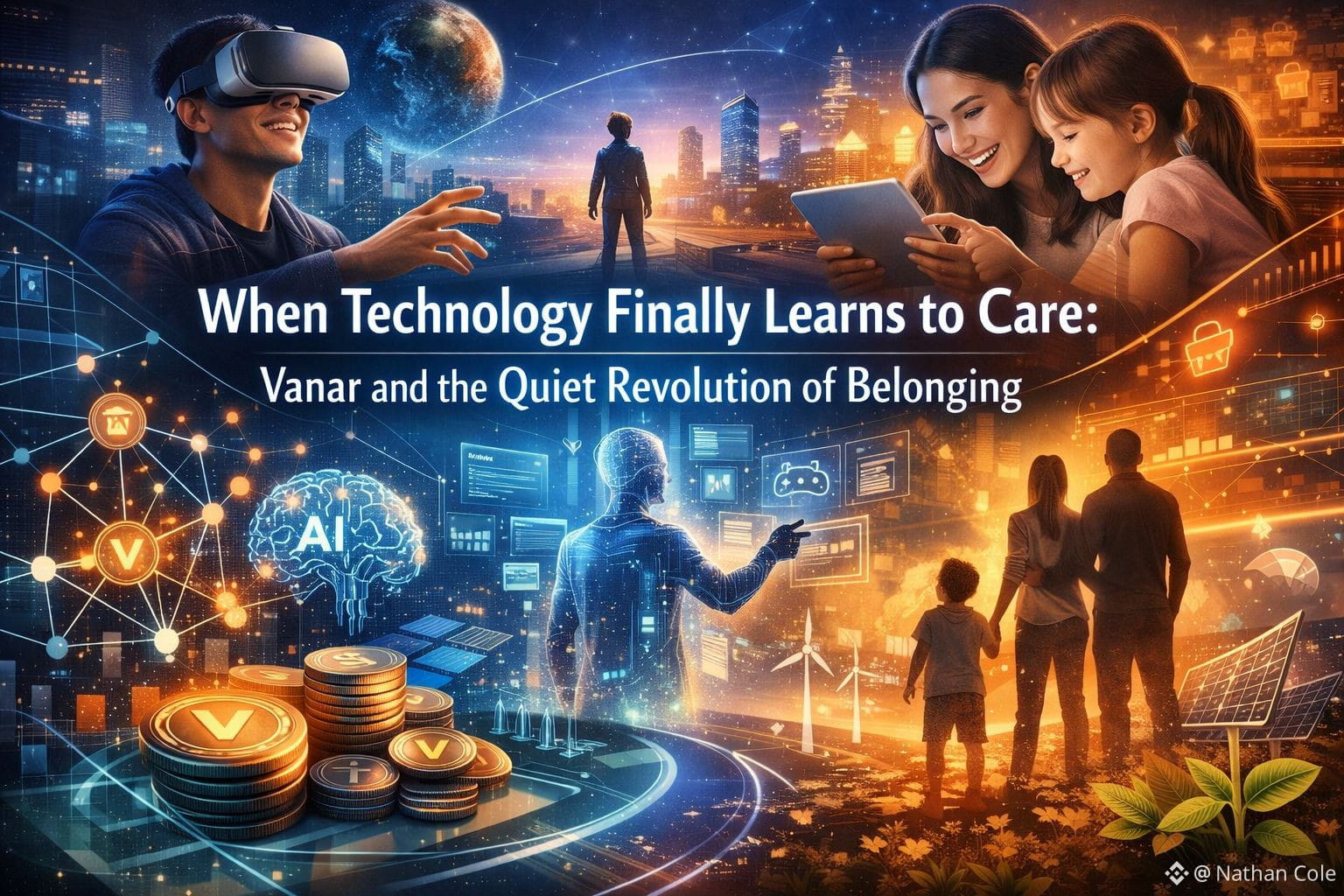
That clarity becomes tangible through its ecosystem. Virtua Metaverse does not feel like an escape from reality; it feels like an extension of identity. It is a place where digital ownership stops being abstract and starts becoming personal. Collectibles are not speculative tokens but memories you can hold. Spaces are not empty virtual rooms but environments shaped by participation. Meanwhile, the VGN Games Network treats gaming not as a financial experiment, but as a universal language. Games are where people learn without realizing it. Where they feel achievement, fairness, and progression. By anchoring Web3 adoption in play, Vanar meets people where joy already lives.
And joy matters. Because mass adoption has never been about technology—it has always been about emotion. People adopt what makes them feel empowered. They abandon what makes them feel small. Vanar’s focus on mainstream verticals—gaming, brands, metaverse experiences, AI-driven services—is not strategic coincidence. These are spaces where identity, creativity, and trust intersect. When a brand uses on-chain infrastructure to prove authenticity, the user does not celebrate decentralization—they feel reassured. When a player truly owns an in-game asset, they don’t analyze token standards—they feel respected.
At the center of this ecosystem flows the VANRY, but its role is intentionally humble. VANRY is designed to power, secure, and align the network, not dominate the user’s attention. In many experiences, it is meant to fade into the background entirely. This is a deeply human design choice. People don’t want to manage currencies every time they create or play. They want continuity. They want value that follows them quietly, faithfully, without demanding expertise. VANRY exists to serve the experience, not overshadow it.
There is also an unspoken tenderness in Vanar’s eco-conscious approach. At a time when technological progress is increasingly questioned for its environmental cost, Vanar’s emphasis on energy efficiency is a recognition that the future must be livable to be meaningful. A blockchain designed for billions cannot afford to be careless with the world those billions inhabit. This awareness adds moral weight to the project—an understanding that innovation without responsibility is just another form of extraction.
Vanar is still early. It is still proving itself. Its ecosystem is growing step by step, user by user, experience by experience. But there is something reassuring in that slowness. It suggests patience. It suggests listening. It suggests a refusal to declare victory before trust is earned. Vanar does not behave like a project chasing headlines. It behaves like one trying to build a home.
If Vanar succeeds, it will not be remembered for a single breakthrough moment. It will be remembered for how little it asked of people. For how gently it introduced ownership. For how naturally it blended into play, creativity, and daily digital life. The next three billion users may never call themselves “Web3 users” at all. They will simply feel that their digital lives finally belong to them.
And maybe that is the most human future technology can offer—not awe, not complexity, but the quiet relief of being included at last.
