

In the world of blockchain, most "AI plays" follow a predictable script. You take a standard Layer 1, add a few off-chain API calls to a model like GPT-4, and call it an "AI-driven ecosystem." It looks great in a pitch deck, but it’s essentially just a traditional chain with an AI skin. The logic still lives off-chain, the data is still siloed in external databases, and the "intelligence" is a black box that the blockchain can’t actually see or verify.
Vanar is attempting to flip that script. Instead of treating AI as an external service, they’ve built a five-layer stack that treats intelligence as a native protocol requirement. They aren't just building a place for tokens to move; they are building a chain that—for lack of a better word - actually thinks.
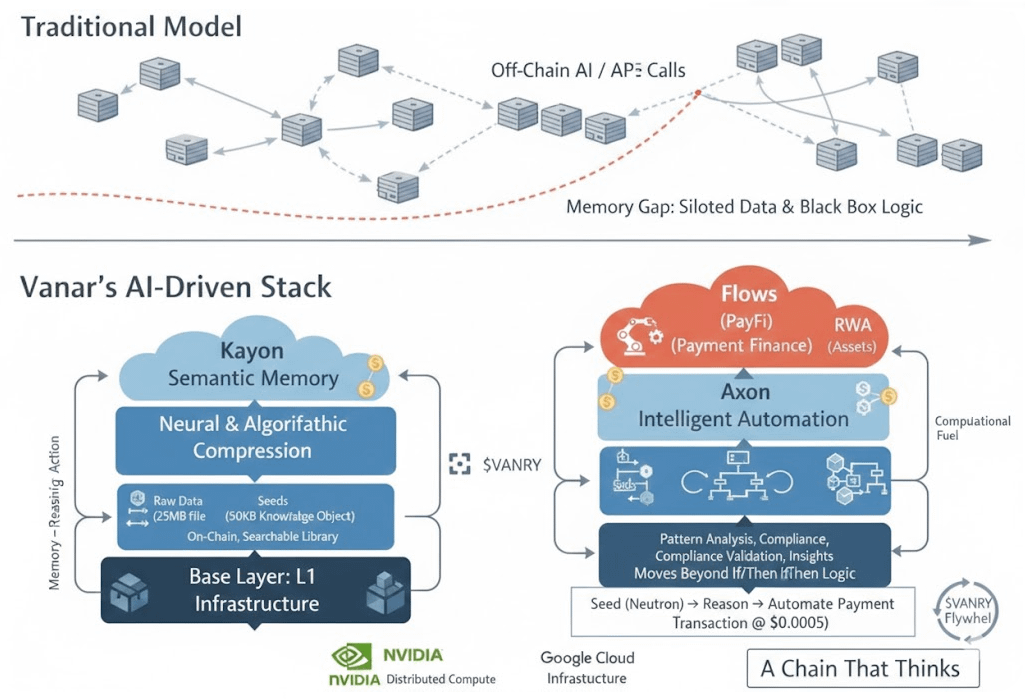
The Memory Gap: Why Neutron Matters
The biggest hurdle for on-chain AI isn't processing power; it’s memory. Blockchains are notoriously bad at storing large amounts of meaningful data. Usually, you get a "hash" that points to a file on IPFS—a dead link waiting to happen.
Neutron, Vanar’s second layer, replaces that brittle model with "Semantic Memory." Instead of raw files, it uses neural and algorithmic compression to turn data into Seeds. We’re talking about taking a 25MB property deed or a complex legal contract and compressing it into a 50KB on-chain object that isn't just stored—it’s readable. When a file becomes a Seed, it becomes a "knowledge object" that AI agents can query directly on-chain. It turns the blockchain from a cold ledger into a searchable, persistent library.
The Reasoning Engine: Moving Beyond If/Then
Standard smart contracts are rigid. They follow "if this, then that" logic. If you want a contract to handle something nuanced—like "pay this invoice only if the compliance documents match the latest local regulations"—you usually need an oracle or a human in the middle.
That’s where Kayon comes in. Positioned as the "Contextual AI Reasoning" layer, Kayon allows the network to reason over the data stored in Neutron. Because it sits inside the stack, it can analyze patterns, validate compliance, and provide insights without ever leaving the secure environment of the chain. It’s the difference between a vending machine (standard L1) and a digital auditor (Vanar).
Closing the Loop: Axon and Flows
Intelligence is useless if it can't act. While Neutron remembers and Kayon reasons, Axon is the layer designed for "Intelligent Automation." It’s built to take the outputs from the reasoning layer and turn them into autonomous on-chain actions.
This leads into Flows, the top layer of the stack where industry-specific applications - like PayFi (Payment Finance) or RWA (Real-World Asset) tokenization - actually live. In a "Flow," an AI agent could theoretically manage a supply chain: it remembers the original contract (Neutron), reasons that the delivery was successful and compliant (Kayon), and automatically triggers the payment settlement (Axon) at a fixed transaction cost of roughly $0.0005.
The $VANRY Flywheel
The economics here move away from simple speculation and toward "computational fuel." In the Vanar ecosystem, $VANRY the gas that powers this entire 5-layer engine. Whether you’re calling a Kayon reasoning query, storing a new Seed in Neutron, or triggering an Axon automation, $VANRY he medium of exchange.
By partnering with giants like NVIDIA for compute and Google Cloud for sustainable, green-energy infrastructure, Vanar is trying to solve the "AI is too expensive for blockchain" problem at the source. They aren't just lowering fees; they are shifting the cost from the user to a more efficient, distributed compute market.
The Reality Check
Of course, building a "chain that thinks" is exponentially harder than building a chain that just moves money. Vanar’s success depends entirely on whether developers actually move away from familiar off-chain AI setups and embrace the "Seed" architecture. Early liquidity is still building, and the more advanced layers like Axon are the ultimate test of the project’s delivery.
But if Vanar succeeds, the result isn't just another L1. It’s a foundational shift where the "plumbing" of the internet doesn't just store your money - it understands why you’re sending it. And in a world moving toward autonomous agents and tokenized everything, that context might be the only thing that actually matters.
#Vanar