

Most people know blockchains as a place where money flows and tokens change hands. Yet, over the past two years, something more profound and important has also been emerging: a place where rules around data, storage, and long-term trustworthiness are defined and enforced by code rather than trust. Walrus is perhaps the most demonstrable example of such a development, and its underlying approach is also one of the more evident examples around storage itself.
In early 2025, a significant milestone was passed by decentralized storage systems. Using data from Messari and Nansen, web3 application storage demand exceeded 30 petabytes, consisting mainly of data from artificial intelligence datasets, non-fungible token media files, gaming assets, and blockchain histories. The approach traditionally taken by decentralized storage systems, including Filecoin and Arweave, had difficulty scaling in an cost-effective manner and thus depended largely on brute force replication techniques, which caused storage costs to skyrocket in a short time. Walrus had entered a space in which storage providers and replication techniques are not leveraged, and instead, storage laws are enforced cryptographically.
Fundamentally speaking, Walrus is a storage system that is built to store large amounts of unstructured data types also termed as "blobs." Blobs are types of files that are not best stored in a blockchain because they are large files which can vary in type and can include items like video and image files. Rather than having nodes store a copy of a file of a particular type, Walrus makes uses of a custom coding style termed "Red Stuff," and what is so unique about "Red Stuff" is that nodes are constantly forced to prove that they are holding their assigned pieces; if they are not able to do so, they are heavily penalized for their activities.
This is where the code for the storage policy begins. Again, unlike with traditional cloud storage, where the enforcement of the policy is through contract, audit, and law, with Walrus, the enforcement happens with the algorithm and contract. When the user sends the data to the cloud, the network generates a proof that the sending of the information happened correctly. This proof is stored in the contract. After that, the storage nodes are periodically expected to answer random challenges that check the storage of the information. If the nodes fail to answer too many of these, they are slashed, meaning the nodes are automatically and mechanically forfeited.
To put it simply, Walrus does not ask nodes to behave truthfully. It forces them through mathematics and economics!
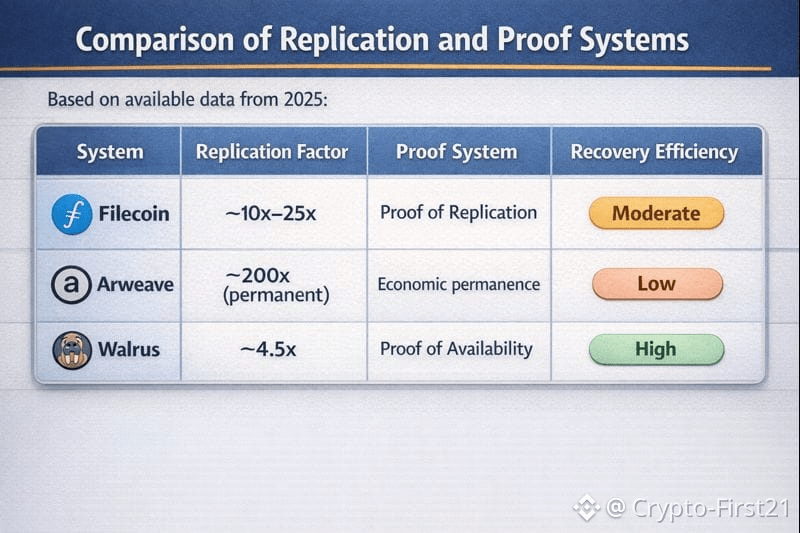
To make sense of the above assertion, it helps to think about the conventional nature of storing information. Usually, a conventional blockchain involves the replication of all data. This is secure but also inefficient. For example, the need for storing a terabyte of information could necessitate the allocation of more than twenty terabytes of space. Filecoin innovates beyond the conventional through the application of proof-of-storage. However, the application of replication is basically central.Walrus, however, approaches things a bit differently. Where its Red Stuff encoding reduces replication down to 4.5x, storing a single terabyte of data only necessitates 4.5 total network storage, a small fraction of what other systems have to recover. Furthermore, when tested and announced publicly around mid-2025, its recovery speeds are 5x greater, utilizing fewer bandwidths during repair.
This is what it ultimately comes down to for storing the rules.
A reduction in replication equates to a reduction in costs but increases risk because if many fail, data could be lost. This issue is addressed in Walrus in the sense that storage guarantees are baked into the protocol. The storage nodes must stake their WAL tokens in order to play a part in this. Their reward comes from their uptime performance, and honesty; their losses are direct and instantaneous if they perform badly.
The reduction of replication also leads to lower costs; however, there will also be a greater chance of jeopardizing the information. Walrus is able to avoid such an issue due to its guaranteed storage protocol. For the nodes that store information to be able to participate and earn money justly, the nodes will be required to stake the WAL tokens.
The WAL token plays a critical role in this model as users pay for data storage for a specified time using WAL, which then accrues on nodes gradually, thus providing them with compensation for storing data as opposed to just holding it. Should nodes vanish prematurely, they stand to forfeit funds as well as part of their stake. Thus, there develops a huge link between economic gain and data reliability through this model.
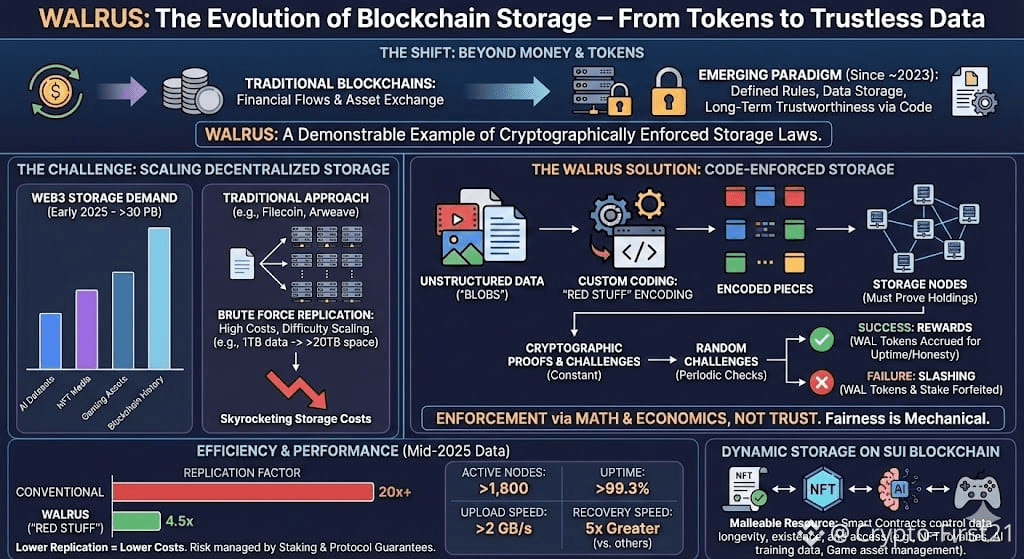
August of 2025, in one of the reports published by Walrus, it was noted that the number of storage nodes that are currently participating in the mainnet of the network exceeded 1,800, while the nodes had an uptime of higher than 99.3 percent. Perhaps more important is the fact that the network is able to accommodate upload speeds higher than 2 gigabytes/second.
What’s interesting about Walrus is its approach to treating storage as a malleable resource. The stored blob can be considered an object that’s placed directly onto the Sui blockchain. You can create smart contracts that can test if the stored information exists, make it last longer, or even eliminate it under certain instances. This provides plenty of possibilities. Consider NFT platforms that can see royalties based upon certain longevity guarantees, AIs that can test if training information exists, or games that can delete assets if they’re no longer being utilized. It’s no longer static.
What’s significant is that infrastructure narratives tend to last longer than hype narratives. For example, in 2021, tokens focused on fast transactions and low fees were widely talked about. Yet in 2024 and 2025, data availability and storage seem to creep up and gain attention because of their connection to AI and related developments in on-chain media. In 2025, spending in decentralized storage exceeded a rise of over 160 percent year-over-year according to CoinMetrics data, compared to an 18 percent increase in volume in DeFi trading.
The most interesting thing for me in Walrus is the enforcement model. Conventional blockchain systems use social consensus and governance elections for dealing with any misbehavior in the network. Walrus uses math, randomness, and economics for this purpose. Walrus does not debate whether a node has behaved correctly or not. It just measures the behavior cryptographically and acts accordingly. So, fairness is mechanical, and this is very rare in distributed systems.
Of course, there remain some challenges that must be addressed. For example, running reliable storage nodes demands strong hardware, bandwidth, and operational discipline. And the system must resist issues such as long-term "data decay," legal requirements, and regional network volatility. However, initial statistics point to steady improvements. Walrus has released several protocol upgrades since its public debut in mid-2024, its nodes have seen performance improvements of close to 40 percent, and the network has developed its layers of encrypting the data through its 'Seal' initiative.
Narratives are a feature of markets; they rise and fall. Infrastructure may not grow or fall so dramatically but accumulates steadily over time, a relentless tide of change. Storage is not a glamorous space in tech terms. It’s unlikely to ever trend in social media or elsewhere. Nevertheless, all digital activity depends ultimately on storage.
Walrus is creating something akin to a decentralized operating system in which rules governing storage are built-in and pricing and availability are predictable and measurable.
If the last decade has been about making money without banks, then perhaps the next decade or two will be about safe storage of data without trust in anybody. Walrus, by enforcing storage policies using code, presents a glimpse of the future of that process.

