

Most crypto infrastructure stories sound exciting in theory and disappointing in reality. Storage networks promise scale but struggle with speed. Execution layers promise speed but collapse under real data loads. For once, Walrus and Sui feel like two pieces that actually fit together. And when you zoom out, the decision starts to make a lot of sense.
If you’ve been in this market for a while, you’ve probably noticed how storage quietly became one of crypto’s biggest bottlenecks. In early blockchains, data was tiny. Transactions were simple. State updates were small. But by 2024, and in 2025, blockchains are hosting NFTs, gaming, AI, social media, and real-world files. End of story. But wait – it turns out storage wasn't an afterthought. It was the actual problem.
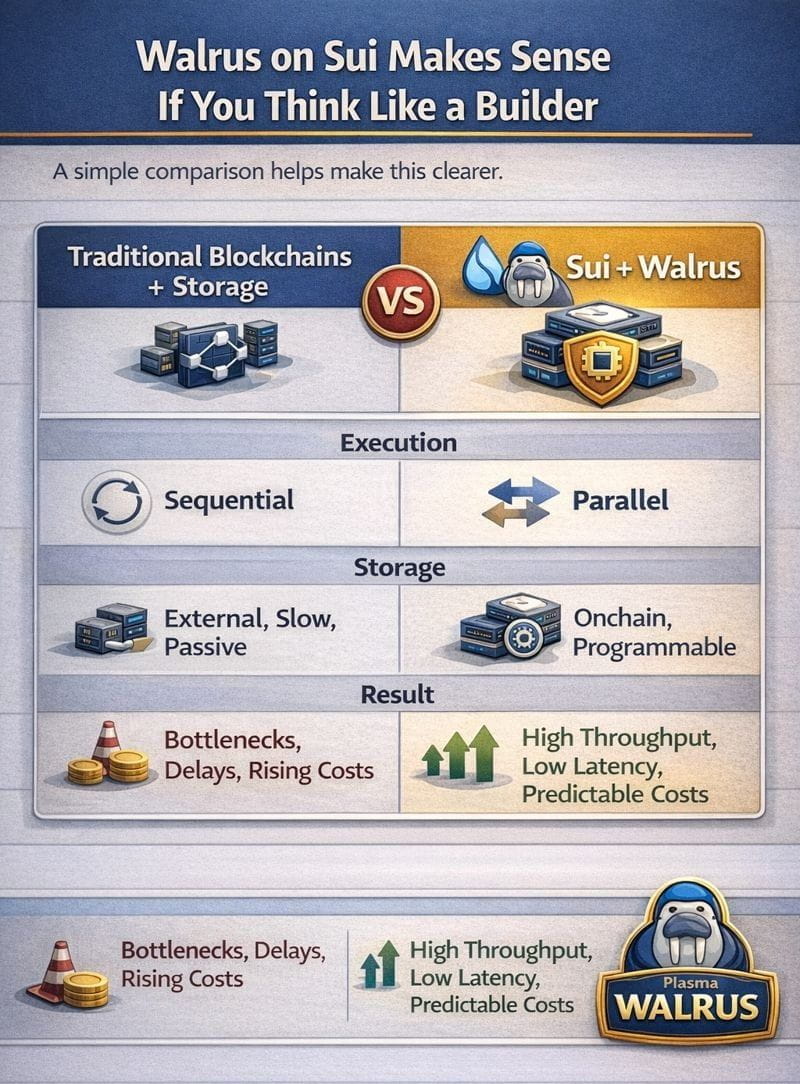
However, this is where Walrus comes in to save the day, as it was created by Mysten Labs, which developed Sui, with its official public mainnet launch happening on March 27, 2025. By that point, Sui had already demonstrated that, when employing their method of parallel execution, they could process transactions at an enormous scale, with sustained throughput of over 100,000 transactions per second on their production benchmarks. Of course, speed is not the only concern when dealing with data-intensive workloads, especially when one needs somewhere to store these large blobs of data affordably, quickly, and safely.
This, in essence, explains Walrus’ decision not to simply build yet another decentralized Dropbox. Walrus chose to build programmable storage. Essentially, programmable storage allows data to not only be stored but also be interacted with. Simply put, apps can, in fact, read, write, authenticate, change, etc. large data sets directly inside onchain transactions. While perhaps not as exciting as it sounds, it's much, much more significant than it could initially be interpreted to be.
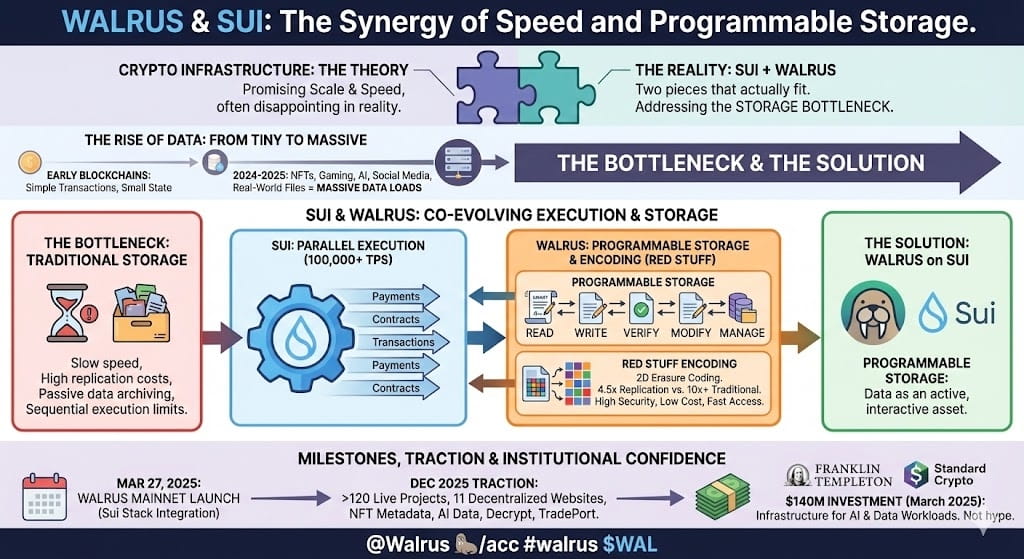
That's where Walrus steps into the picture. Walrus is a creation of the same team that built Sui. Walrus has officially announced the mainnet. As the team behind Walrus suggests, the mainnet became publicly accessible on the 27th of March, 2025. This has been a carefully timed unveiling. As can be anticipated following the success and large-scale transactions that Sui has successfully processed with the ability to achieve a continuous transaction rate greater than 100,000 transactions per second, speed without a proper storage facility would only be half the job.
This is why Walrus didn’t just build another decentralized Dropbox. It focused on programmable storage, meaning data is not just stored, but can be interacted with by smart contracts. In simple terms, apps can read, write, verify, modify, and manage large data files directly inside onchain workflows. This matters far more than it sounds. It turns storage into an active part of execution, instead of a passive archive.
Why does this require Sui specifically? The main reason is that most blockchains execute these types of transactions sequentially. When storage is rapid, execution becomes a limiting factor. With Sui, however, independence and parallel execution allow many storage actions, payments, and contract calls to actually happen in parallel, rather than having to wait for a sequence. With Walrus, storage and execution scale without competing or conflicting.
That alignment explains why Walrus was built as part of the Sui stack instead of as a generic multi-chain service. Storage and execution needed to co-evolve.
The technical innovation inside Walrus also deserves attention. Its core encoding engine, called Red Stuff, uses a two-dimensional erasure coding model. In simple language, it splits data into fragments in a way that lets the system recover files even if large portions of the network go offline. According to research published in mid-2025, Walrus achieves strong security with only about 4.5x replication overhead, compared to 10x or more in many decentralized storage systems. This implies that storage costs remain low, while at the same time, data access speeds increase.
Walrus had crossed 120 live projects by December 2025, had 11 decentralized websites, and was storing large-scale NFT metadata, AI data, and content for platforms like TradePort and Decrypt. All this may not seem like a big achievement compared to Web 2.0 giants, but for decentralized platforms, this kind of usage in just under a year after mainnet deployment was a big achievement.
This traction is what also enabled the institutional funds that followed suit. In fact, in March 2025, Walrus invested $140 million alongside major funds like Franklin Templeton and others, led by Standard Crypto. That $140 million was not invested in hype alone. It was invested in infrastructure for data workloads to cater to AI for the next decade.
That is where timing becomes critical, and that is exactly where on-chain AI agents, autonomous workflows, and machine learning models have defined the significance of storage.

