

For many years, the subject of privacy and blockchains had an interesting, yet uneasy coexistence. Blockchains are, or at least attempt to be, overly transparent, yet finance, particularly institutional finance, thrives on secrecy. Dusk ranks amongst some of the few attempts to bridge the divide, not only through rhetoric, but through actual technical implementation, which is finally starting to yield traction.
As someone who has had enough time to listen and observe cryptocurrency markets over time, you know that every narrative tends to come back down to Earth whenever someone mentions regulations. The difference, however, for Dusk is its origins. Unlike most coins, which struggle against regulations, Dusk began its life out of, rather than in spite of, regulations. Instead of creating a coin focused on privacy and hoping for regulatory acceptance, Dusk created a financial blockchain focused on both privacy and auditing. Naturally, this sounds highly technical, but in 2025 and early 2026, this was all brought to life.
Dusk also carried out a significant Layer-1 upgrade in January 2026, releasing DuskEVM, which now makes it Ethereum-style smart contract compatible while maintaining native-layer privacy. While it might have been useful to developers, it’s also meaningful to regulated financial apps that can now perform secret logic while hiding transactions from public knowledge. By doing so, Dusk sits in a minority of blockchains that are applicable at a financial level.
In order to grasp the background behind this, it's helpful to think about how most blockchains handle this issue. Bitcoin, as noted, provides pseudonymity but not privacy. Ethereum, as discussed, makes this situation worse. There are blockchains that, like Monero or Zcash, prioritize user privacy, but this causes difficulties with regulators. There's space for something which provides private transactions, but which can, through existing legal structures, be audited – that's essentially what Dusk claims to be.
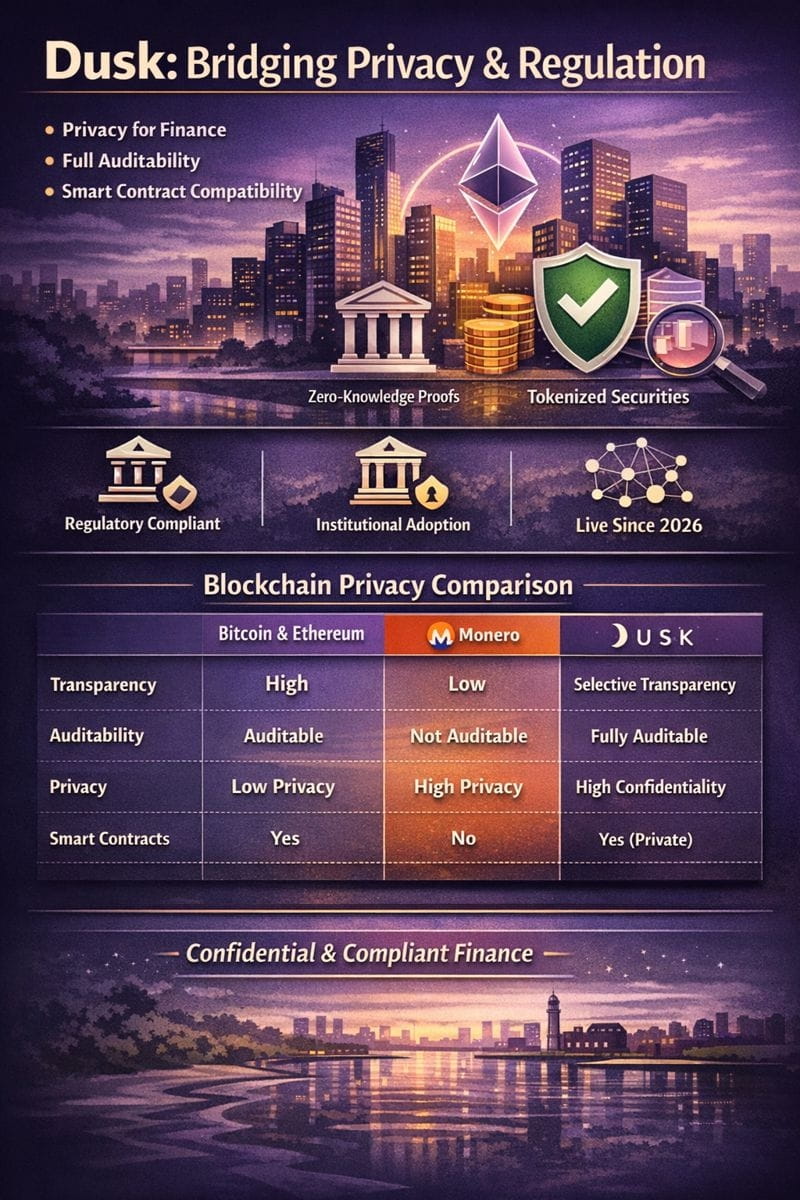
In technical terms, Dusk employs zero-knowledge proofs, which refer to asymmetric encryption-based methods for verification. This implies that an individual is able to demonstrate proof of compliance with regulations without disclosing what exactly was involved. This is particularly crucial for numerous financial products such as bonds, stocks, along with derivatives, where non-disclosure is mandatory.
Dusk also added the capability for confidential Smart Contracts. It did not add an afterthought in privacy. It actually executes encrypted codes at the base. It is because of these features that institutions are beginning to test Dusk for its usage in tokenized securities. In fact, in November 2025, Dusk collaborated with Chainlink and the NPEX stock exchange for the tokenization of more than €300 million in regulated securities via Dusk’s privacy-preserving Settlement Layer. Those are not experimental assets. It is market infrastructure.
What makes this more than simply a theoretical experiment, however, is that these platforms are live. Dusk’s mainnet was declared completely operational in early January 2026, and only weeks after that, it was being used for testing compliant digital security issuances. This is compared to most other private chains that still exist in primarily retail speculation environments. Dusk’s goal here isn’t retail hype.
What makes this not just a theoretical exercise is that the environments are live. Dusk's main network has been entirely operational since early January 2026. In a matter of a few weeks, the network has already begun test issuances with compliant digital securities. One can only imagine how different this is from the many other privacy chains that are still stuck primarily within the retail speculation circulating environments. Dusk is not primarily pursuing retail hype; it’s pursuing institutional plumbing.
Consider the following analogy to appreciate these technical trade-offs:
The public ledgers such as Ethereum provide transparency, low levejls of privacy, and high composability. However, this data cannot be used by institutions.
Monero, like privacy-first chains, has the following properties: high privacy, low auditability, and near zero compatibility with the
"Dusk seeks selective privacy - high confidentiality for its transactions, full auditability under the law, and composability of smart contracts using standard Ethereum tools."
This is why it took a bit long to get to production; compliance awareness is harder than full opacity. Also, this explains why they are taking notice of institutions now.
From a broader point of view, this is all taking place in an ecosystem that, from a market perspective, is growing, particularly in terms of tokenized real-world assets. In fact, in 2024, global tokenized asset value exceeded $6 billion. As far as December 2025 is concerned, industry reports indicated live on-chain values for over $12 billion in tokenized securities, funds, and bonds. The desire for exposure for traditional players, however, does not come with the desire for all trades to become public. Therefore, here is where Dusk comes in.
The interesting thing, from an investor point of view, is how low-key all of this is occurring. While everyone is talking about meme-based coins and their latest price increases, funded infrastructure is being quietly deployed. I’ve watched this occurrence before. In 2019, no one really talked about custody providers. Then, in 2021, it became perhaps the largest financial institutional theme. The same thing is happening now with financial privacy. It’s boring before it becomes incredibly important.
Technically, Dusk also uses a consensus model called Segregated Byzantine Agreement that separates transaction execution from consensus, allowing higher throughput while keeping transaction data encrypted. In internal benchmarks published during late 2025 testing, Dusk showed consistent throughput above 1,000 transactions per second under encrypted workloads, far above most privacy chains struggling past 100 TPS. That performance ceiling matters if real trading volume ever moves on-chain.
Another piece which gets overlooked is identity. Dusk built out a private identity system called Citadel, that allows users to signal compliance status without leaking personal data. In regulated finance, identity is, of course, everything. But public identity is dangerous. Citadel uses zero-knowledge proofs to confirm that a user passed KYC without exposing who they are. This is the kind of subtle technical layer that institutions quietly demand before onboarding.
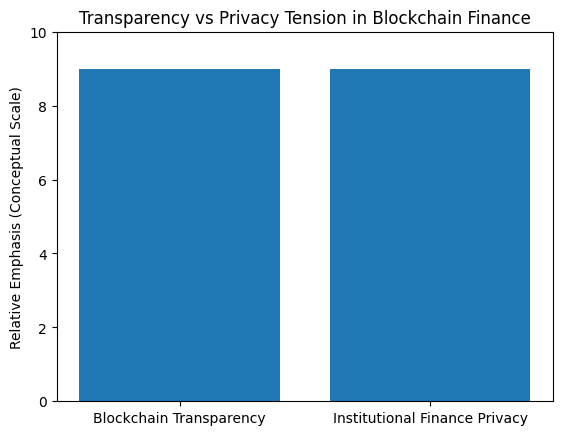
Why's this trending now? There are two reasons. First, there is a better regulatory clarity. Europe's MiCA framework and similar Asian regulations are pushing the financial firms to explore blockchain rails under strict compliance rules. Second, infrastructure is finally mature enough to handle encrypted computation at scale. It was, for the most part, theoretical back in 2018, but in 2026, it's operational.
There is also a broader narrative shift happening in crypto. The market is very slowly rotating from pure speculation toward utility-driven infrastructure. Payments, tokenization, and compliance layers replace meme cycles. Dusk sits right in that rotation. Not flashy. Not viral. But increasingly relevant.
Personally, I am still skeptical. It's a sensitive balancing act to create privacy systems that regulators can live with. One wrong move, one changed regulation, and adoption will stall. Technically speaking, however, Dusk is one of the few projects that really recognizes this tension rather than trying to wish it away. That fact alone makes it stand apart.
Because, technically speaking, privacy on chain is not about hiding everything. It's about showing only what needs to be shown. That principle deeply resonated with Dusk's architecture. The fact that it will go mainstream depends on execution, partnership efforts, and regulatory alignment. But that's no longer a theoretical foundation. It is live, operational, and already touching real capital.
In a market often obsessed with speed and hype, Dusk is silently building up slow, regulated, institutional-grade plumbing. And in crypto, the projects that build the plumbing usually matter more than the ones that build the billboards.
