


Plasma is developed with a simple yet infrequent crypto-concept: execution is the product. Plasma does not consider transaction processing as an incidental consequence of programmability or decentralization, but execution is the primary output. All the architectural decisions are derived out of a question: what is a way to ensure that transactions flow through the system with the least amount of friction, delay, and uncertainty?
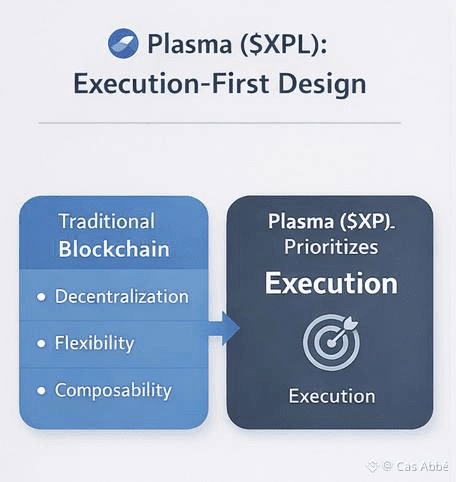
Such framing affects the behavior of the chain under stress. Plasma does not decay randomly or unpredictably when the activity is spiked. It is built in such a way that the quality of execution is not compromised as the demand grows, which is one of the important qualities of financial and transactional systems that cannot sustain an extended downtime or a lack of reliability.
The Real Optimization of What Plasma Is.
Plasma is deterministic-executable. This implies that after making a submission, a user can have a reasonable understanding of when it will run, how it will run at what cost and probability of success. Numerous blockchains optimize openness or expressiveness in the first place, resulting in unpredictable execution behavior.
The vast majority of congestion issues with blockchains are not dictated by the number of users, but by shared execution environments in which all the transactions are competing over the same global resources. Friction is minimized by plasma; this is achieved through simplification of the paths of execution and the restriction of unnecessary interaction of states. The lesser the dependencies the lesser the surprises.
Plasma is more reminiscent of traditional financial infrastructure than experimental blockchain platforms by applying execution as a production system as opposed to a research environment.
The reasons why Plasma does not heavily generalize.
General-purpose blockchains are intended to enable all types of applications on a unified layer. Although this may appear to be a strong statement, it brings about severe structural inefficiencies. Each new contract, feature or engagement adds complexity to the world and delays every user.
Plasma is specifically intended to escape this trap. Rather than allowing the limitless contract-to-contract interactions, it limits the interaction of components. This limitation decreases common bottlenecks and simplifies execution behavior into reasonable questions. In systems involving real economic value, flexibility is traded against reliability and in many instances, this is the right trade.
This construction renders Plasma less appealing to experimental or creativity-driven tasks, and much more appealing to high-frequency and repeatable workflows where consistency in performance is of more importance than the ability to be creative.
Execution Predictability as a Design Principle
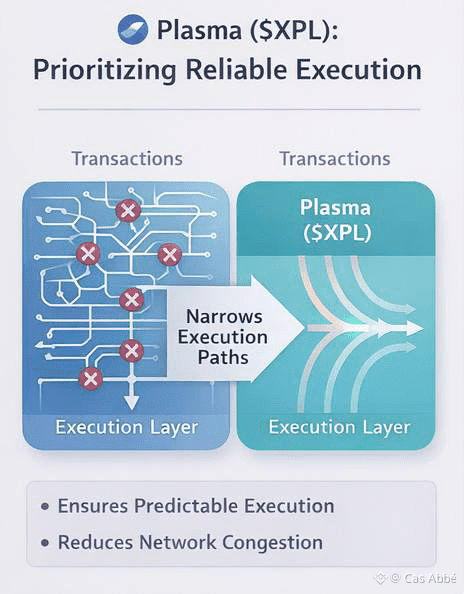
Predictable load execution is one of the least mentioned but most important strengths of Plasma. In most blockchains, the performance is non-linearly decreasing with the increase in the activity. The prices skyrocket, the time to confirm is prolonged, and clients have to pay more to be accommodated.
Plasma diversifies this mess by matching the capacity to execute with economic indicators. Transactions that are more valued by users are automatically valued and ones with low value or spam-like behavior are priced out. This makes the network not go out of use when the demand is highest but rather be made available.
The predictability is not a technical feature only, but a feature of usability which defines the possibility of real-world systems to be confident of relying on the chain.
The Economics underlying XPL.
The XPL token is not created as an implementation of payments, it is an execution demand coordination mechanism. Plasma is an economic pressure approach that settles on the types of transactions worth attention in order to preserve the limited resources rather than a one-size-fits-all gas model.
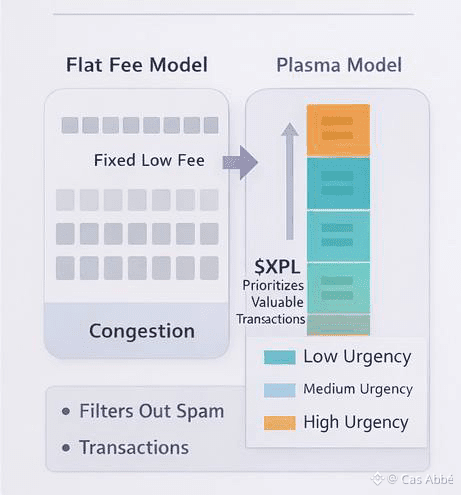
This means that nobody will want to engage in wasteful behavior because it will not be achieved through the use of heavy-handed restrictions. The value of speed and certainty can be economically expressed by users who place a high value on those aspects, and casual or not-urgent transactions are transactions that, however, wait or cost less. This makes a more rational transaction market.
Eventually, this model stabilizes network behavior. Plasma has smoother demand curves, where intense bursts of fees do not happen and therefore, both users and applications find it easier to plan cost and time.
How $XPL Shapes User Behavior
Since $XPL is directly proportional to execution results, it is one that makes one think about transaction quality, rather than transaction quantity. This changes the culture of the network where it is used heavily with spam into a deliberate interaction.
The cost of execution is significant and that makes users less likely to make non-needed transactions. This helps in keeping the network devoid of congestions and unimpedes performance of serious players. What is left is a cleaner environment of execution with less distortion because of speculative or abusive activity.
This influencing of behavior is not so much but still a powerful one and this is one of the reasons why Plasma is focusing on economics rather than strict technical enforcement.
Trade-Offs: What a Plasma Contradicts.
The execution-first philosophy is real in terms of sacrifice of plasma. Plasma sacrifices some of the openness of more experimental blockchains in order to offer more performance and composability. All ideas do not fit in their model of execution.
Decentralization of the validators can be additionally more limited as the execution efficiency usually presupposes closer coordination and performance requirements. This may restrict participation as opposed to systems that are totally permissionless.
Nevertheless, such trade-offs are deliberate. Plasma is not attempting to raise ideological purity to maximum--it is attempting to raise operational reliability to maximum.
The Rationale behind these Trade-Offs.
Plasma presupposes that not every blockchain should target the same group of people. There are chains to investigate the possibilities; there are chains which are aimed to provide stable results. Plasma obviously takes the second way.
Plasma loses the extreme flexibility, which provides it with a system that will behave similarly to that when strains occur, as when calmness is present. This is a property that is uncommon in crypto and useful to applications that cannot accept execution risk.
Who Plasma Is It Built to Serve.
Plasma is not designed to be used in informal experimentation or on-meme-based adoption. It is designed regarding users and applications, which are concerned with repeatability, reliability, and certainty of execution.
When the predictability of a blockchain on a day in day out is required of you, Plasma fits the description. It may not be as much what you want in the case of infinite experimentation and unrestricted composability.
Plasma does not want to make friends with everybody. It is making an attempt at all times.

