

On this Super Wednesday, the market already considers it certain that there will be no interest rate cut by the Federal Reserve. This consensus helps explain the VIX at 16.89, a level that places it in the range of moderate volatility and in the alert zone. However, the dollar remains weakened, a direct reflection of the political and economic decisions of President Donald Trump. This movement led investors to abandon the U.S. market in search of safety in metals, driving a rally led by gold and silver.
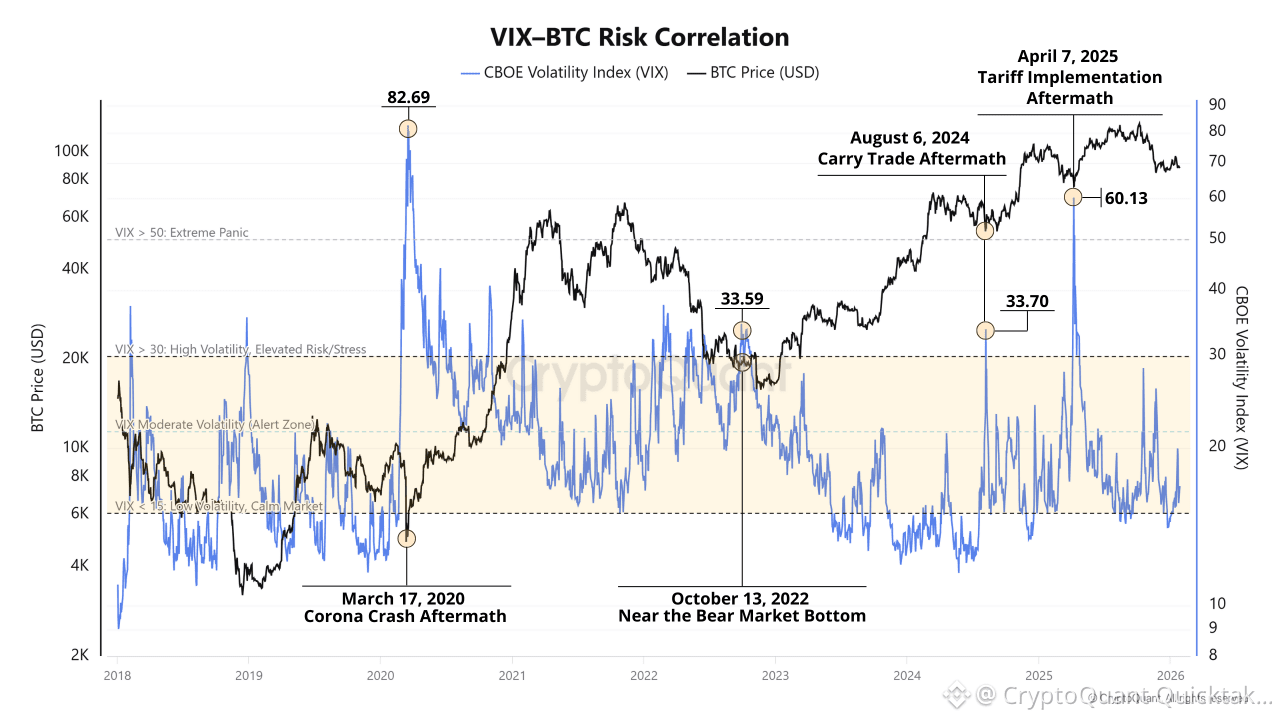
In this environment, the **VIX–BTC Risk Correlation** gains prominence. The indicator measures how peaks of volatility in the traditional market (VIX) are connected to local and cyclical bottom movements of Bitcoin. The tool offers a clear reading of the correlation between risk in TradFi and opportunities in the crypto market, functioning as a thermometer of inflection in moments of stress.
FOMC MEETING DATA
◾In 2025 → Bitcoin fell in 6 of 7 FOMC meetings.
◾Average drop → 7.47% in days.
◾Current rate → between 3.50% and 3.75% per year, lowest since September 2022.
◾Repurchase → The Fed announced it will repurchase US$ 40 billion in Treasury Bills over 30 days.
VIX–BTC RISK CORRELATION DATA
◾VIX level → 16.89 → alert zone, indicating moderate volatility.
◾History → signaled the last two local bottoms of the cycle.
◾Previous Bear Market → also identified the bottom of the last bear cycle.
◾Interpretation → in high volatility and risk, the indicator reinforces correlation between stress in TradFi and BTC inflection points
CONCLUSION
The global market bets an interest rate cut by the Federal Reserve should only occur in March or September. Meanwhile, the VIX–BTC Risk Correlation shows that even with stable rates, risk remains. The current reading suggests the crypto market stays sensitive to stress promoted by the U.S., and Super Wednesday may be another test of this correlation between volatility and Bitcoin bottoms.
Written by GugaOnChain