
1.
The night before last, my 80,000 order was executed, and later I realized I was wrong, so I immediately cut my losses and exited. Although February 2 is a full moon, and in the past few years, most full moons have led to price increases, this time it really might not be the case. The specific situation will depend on the thoughts of large capital regarding short positions, as this is the only reason for a rebound. The market itself is currently very weak.
2.
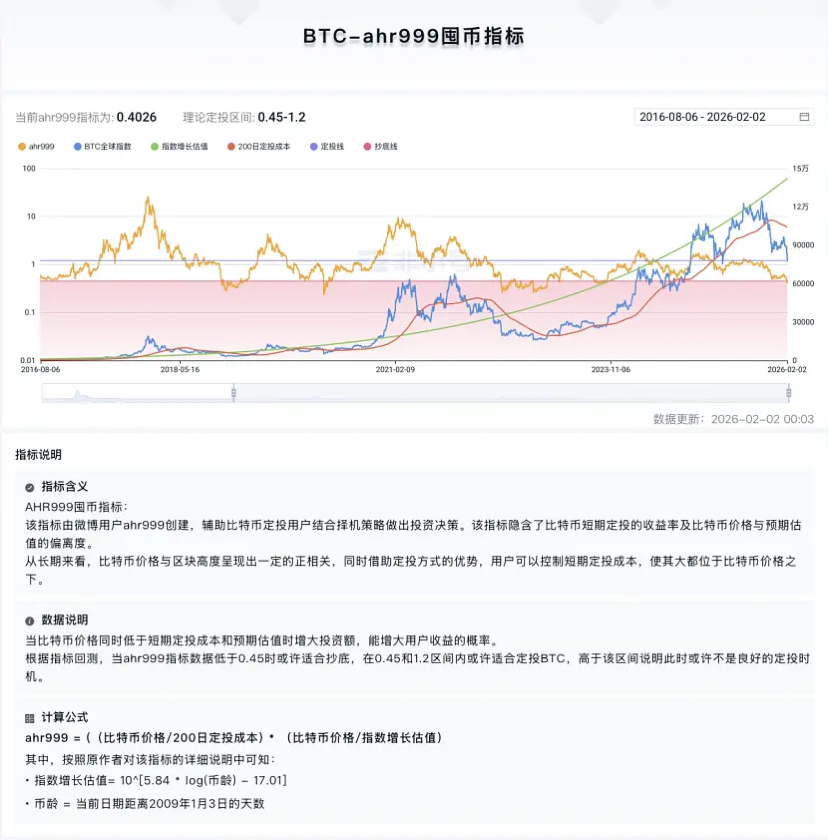
The ahr999 indicator is currently around 0.4, which is quite exaggerated. It is equivalent to the position of entering the bottom line around June 10, 2022. At that time, BTC dropped from 27,000 to 22,000 that week.
If we view it from the perspective of ahr999's boat-casting method, BTC could still drop by 40%, which means it would ultimately reach around 47,000.
However, AHR999 did not significantly break through the dollar-cost averaging line 1 in this bull market, indicating that BTC's price did not greatly exceed the index growth valuation.
In such a mild and slightly weary bull market, will Bitcoin really drop significantly below the shutdown price of mining machines like it did in 2022?
The lowest point in 2022 was 15450, and at that time, the shutdown price of mining machines was in the range of 23000-27000.
Three,
The cumulative peak of ETF inflows for BTC in this bull market is about 60 billion dollars, with an average cost in the range of 8.4-8.6.
A total of 10 billion has already flowed out, with 50 billion remaining.
The current price is around 77,000 to 78,000.
ETF investors are already at a loss.
Can BTC really remain significantly lower than the ETF cost price for a long time?
Four,
The achievement of the lowest point in the 2022 bear market was mainly due to the FTX failure.
This would mean that for BTC to drop to 4.7, a giant exchange like OKX would need to face a massive failure.
Five,
From the performance of altcoins, taking ADA as an example, it is currently 0.29, down 78% from the peak of 1.3.
Clearly, this situation is not deep enough into a bear market.
The previous bull to bear transition fell by 92%.
Doge is similar. From 0.5 to 0.1 is only 80%. In the last round, it fell from 0.74 to 0.05, a drop of 93.3%.
Altcoins are suitable for long-term short contracts in a bear market (though not recommended), while Bitcoin is suitable for dollar-cost averaging in spot purchases at the bottom of the bear market.
The altcoins that have had a bull market this round are nothing but XRP and SOL, making predictions extremely difficult. In terms of multiples and safety, compared to Bitcoin, they are not very impressive. In the next bear market, altcoins will still not be worth holding.
There is even a saying that the major obstacle hindering Bitcoin is actually the altcoins.
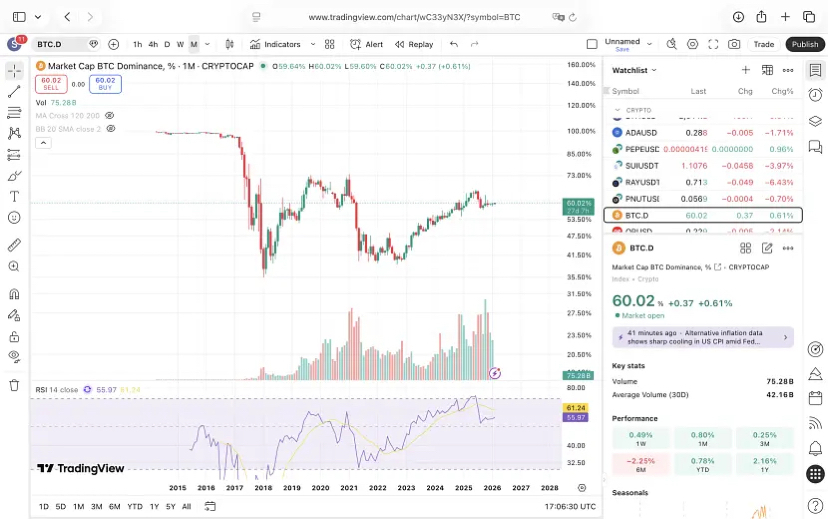
The BTC.D indicator, which reflects Bitcoin's dominance, was actually distracted from investors' attention by altcoins during the bull markets of 2017 and 2021.
And this is just a misunderstanding.
It is more likely that BTC.D will continue to rise in the long term.
As the king of value storage set to replace gold, such a trend is also to be expected.
Six,
In summary, AHR entering the bottom line too early means that one cannot view the bear market according to the trend and pace of the previous round.
Unless there is a massive failure, it is hard to expect Bitcoin to easily drop below 50,000.
Once entering the shutdown price range of 60,000 to 65,000, one should start dollar-cost averaging.
It is almost certain that Bitcoin's long bull market will come in the not-too-distant future. This bear market may indeed be the last one with significant amplitude.
One should prepare ammunition to heavily invest during the deep bear market; the current index growth valuation has reached 14,200.
If the next bull market peak appears in 2029, the index valuation of AHR999 will reach a million dollars.
If Bitcoin's price can touch the index valuation, the returns will be very considerable.