Introduction
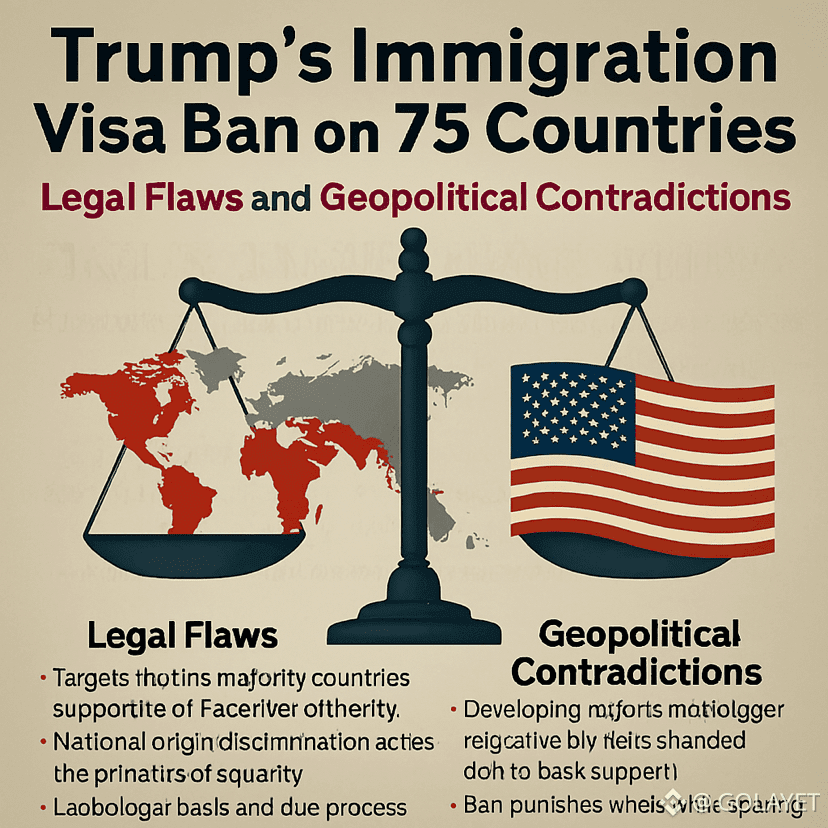
In January 2026, President Trump’s administration announced the suspension of immigration visas for citizens of 75 countries. The stated justification was economic: migrants from these nations allegedly impose a burden on U.S. welfare programs. Yet upon closer examination, the decision reveals serious constitutional flaws and exposes geopolitical contradictions, particularly in relation to U.S. alliances with Israel. This article consolidates prior analyses into one comprehensive text, highlighting the stark conflict between the U.S. Constitution and this executive action.
---
Declared Basis vs. Reality
• Declared rationale: Protecting the U.S. economy from the burden of migrants.
• Reality: Countries such as Mexico, India, and the Philippines—major sources of migration and economic strain—were excluded.
• Conclusion: The ban is not purely economic but selectively political, punishing states supportive of Palestine while sparing allies of Israel.
---
Constitutional and Legal Defects
1. First Amendment (Freedom of Religion)
• Prohibits laws targeting a specific religion or restricting its practice.
• Most banned countries have Muslim majorities, making the measure a form of implicit religious discrimination.
2. Fifth Amendment (Due Process)
• Guarantees that government actions must follow fair procedures.
• The ban lacks solid data and relies on political selectivity, violating procedural fairness.
3. Fourteenth Amendment (Equal Protection)
• Ensures equal protection under the law for all persons.
• The ban discriminates based on national origin and religion, directly breaching equal protection principles.
---
Geopolitical Contradictions
Countries Exempt Despite Economic Burden
• India, Mexico, the Philippines, Nigeria, Turkey: all developing nations with high migration rates, yet excluded.
• Reason: Strong ties with Israel or strategic support for U.S.–Israeli interests.
Countries Included Despite Alliances
• Egypt, Brazil, and Russia were listed despite being economic or political partners.
• Contradiction: Allies punished while heavier burdens are spared.
Negative Impact on the U.S. Economy
• Migrants from banned countries contribute significantly in healthcare, agriculture, and technology.
• Blocking them creates labor shortages and weakens the economy.
• Paradox: A policy claiming to protect the economy actually undermines it.
---
Expanded Comparative Table
Country Economic/Migration Status Relationship with Israel Contradiction
India Developing, massive migration Extensive military & tech cooperation Clear burden yet exempt
Mexico Largest source of U.S. migration Formal diplomatic ties Exempt despite being top source
Philippines Major labor migration Stable relations Exempt despite economic strain
Nigeria Largest African economy, rising migration Security & agricultural cooperation Exempt despite burden
Turkey Economic crisis, notable migration Intelligence & trade cooperation NATO member, exempt
Ukraine Economic crisis, heavy migration Close ties with Israel Exempt despite burden
Poland Significant migration Strong ties with Israel Exempt despite burden
Romania High migration Formal ties with Israel Exempt
Indonesia Largest Muslim-majority nation Indirect trade with Israel Exempt to avoid political crisis
Argentina Economic crisis, migration Formal ties with Israel Exempt despite burden
Colombia Migration source, economic crisis Strong ties with Israel Exempt
South Africa Notable migration Economic cooperation with Israel Partially exempt
---
Judicial Precedents
Trump v. Hawaii (2018)
• Concerned Trump’s earlier travel ban on Muslim-majority countries.
• The Supreme Court upheld the ban, citing broad presidential authority under the Immigration and Nationality Act (INA).
• Yet the Court acknowledged controversy over religious discrimination and affirmed that executive actions must be reviewed if based on illegitimate grounds.
• The 2026 ban is even more selective and discriminatory, making it more vulnerable to judicial reversal.
Other Cases
• Chy Lung v. Freeman (1875): States cannot enact discriminatory immigration laws.
• United States v. Texas (2023): Immigration policies must respect due process.
---
National Interest Impact
• Weakens the U.S. economy by reducing skilled labor.
• Damages foreign policy and global reputation.
• Projects the image of the U.S. as practicing political and religious discrimination, contrary to constitutional values.
---
Conclusion
Trump’s 2026 immigration visa ban for 75 countries is not an economic safeguard but a racially and politically biased measure serving a geopolitical agenda tied to Israel. The contradictions are stark: economically burdensome allies are spared, while poorer nations supportive of Palestine are punished. This selective targeting proves the ban is unconstitutional, violating the First, Fifth, and Fourteenth Amendments, while harming both the economy and U.S. foreign relations.
Therefore, the Supreme Court must intervene to overturn or suspend the ban, preserving equality, religious freedom, due process, and the true national interest.