


Walrus doesn't fail when data disappears. It fails earlier when someone says it is there and nobody can prove it fast enough.
The first time this hits you up is not dramatic. No alarms. No red dashboards either. Just a pause. A hold that wasn't planned. A question that lands badly timed from one of engineers...
can we assert availability now or are we still operating on belief?
Plenty of storage systems run for a long time on belief. Nodes behave. Operators do what they are supposed to do. Retrieval works often enough that nobody asks hard questions actually. Availability turns into a mood. "It's there" feels safe until someone needs it to be defensible inside a window that does not wait... and now the room gets smaller.
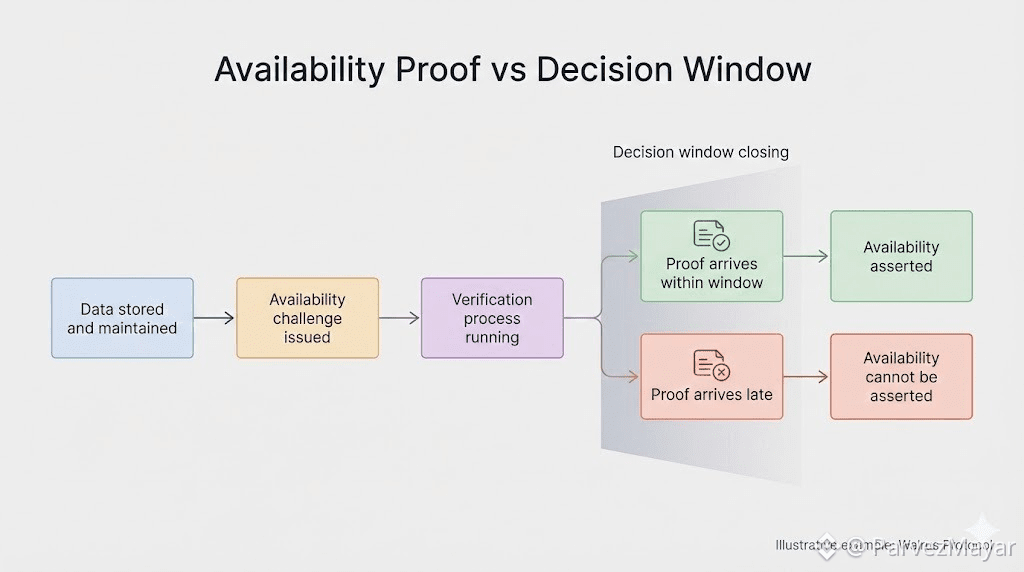
The pressure is not cryptographic elegance. It's timing for Walrus. A proof that arrives late is indistinguishable from no proof at all when a release, a settlement, or a sign-off is waiting. The system can be correct in theory and still block action because correctness did not surface when it mattered.
Small teams can swear. At scale... swearing turns into backlog. Storage that is not just durable, but challengeable on demand, because trust gets lazy when the system gets big. Not malicious. Just... convenient.
The awkward moment is when confidence outpaces verification and somebody has to write the line.
You see it when someone tries to close a loop and can't. The data has not vanished though. Nothing is technically wrong. But the system can not demonstrate availability inside the paid term, so the desk hesitates. Not because they expect fraud. Because they can't put 'available' into an incident note without adding a footnote they will regret.
"Cannot assert availability inside current term... verification pending'.
Not a feature. A gate. And gates don't care if you feel confident. Either the system can assert availability in time or the workflow stalls. There's no middle state that feels good. A claim without a check is just confidence waiting to get embarrassed.
Protocols' Operators feel it first. Not at setup not during normal operation.. but when challenges start arriving in patterns that aren't polite. Back-to-back. Correlated. Inside the same Walrus' epoch. Proof work starts competing with everything else that wants the pipe... and suddenly it is not "does storage exist", it is all of sudden "can we answer right now."
Because the release train doesn't wait for your confidence.
And that's uncomfortable, the system stops rewarding good intentions. You do not get credit for storing data correctly if you can not show it when asked. You don't get credit for long term durability if short-term verification slips. For protocols using#Walrus though Availability turns from a background assumption into an active obligation.

I've seen teams try to talk their way around this. Not maliciously. Just habit. "It is there, we checked earlier". That sentence works right up until the challenge lands outside the comfortable window. After that... it doesn't clear anything.
People stop treating proofs as something that "runs in the background." They start treating them as part of the critical path. They design around challenge timing the same way they design around gas spikes or block delays. Fewer arguments about whether data exists, more arguments about whether they can prove it now. Not trustlessness. Not security theater. Just less room to bluff.
Walrus either does not eliminate the possibility of failure. @Walrus 🦭/acc to be honest, removes the ability to hide behind confidence when verification lags. If a challenge is pending, certainty is pending too... and that is part no teams and protocols enjoys.
A lot storage looks fine until someone asks it to answer like it's sworn. Walrus Protocol forces that moment earlier, while the system is still running, while repair is still happening, while everyone would prefer to assume things are okay.
"Hold. Pending'.

