
I found out the hard way why Walrus is different. It happened on a Tuesday when my local network was acting like a total disaster. I was trying to upload a large file and half my connection just died mid-stream. Usually that means the file is broken or I have to start over from scratch because the data did not land everywhere it was supposed to go.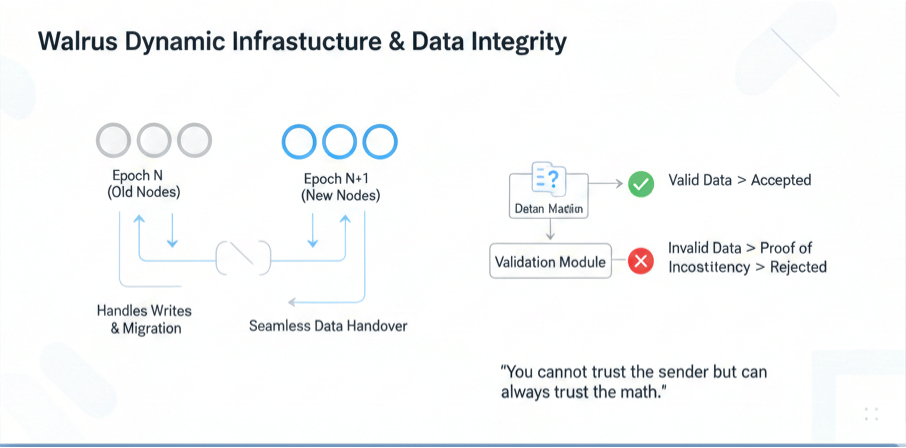 In most systems if a node crashes or the internet hiccups while you are saving something the data just stays in this weird limbo. But with Walrus I noticed something strange. Even though my connection was failing the system just kept moving. It felt like the network was actually helping me fix my own mistakes in real-time.
"The network does not need every piece to be perfect to keep your data alive."
That is the first thing you have to understand about being a user here. When we upload a blob which is just a fancy word for any big chunk of data like a photo or a video it gets chopped up. In other systems if the storage node meant to hold your specific piece of data is offline that piece is just gone until the node comes back. Walrus uses this two dimensional encoding trick that sounds complicated but actually works like a safety net. If a node wakes up and realizes it missed a piece of my file it does not just sit there being useless. It reaches out to the other nodes and asks for little bits of their data to rebuild what it lost.
I realized that this makes everything faster for me as a consumer. Because every node eventually gets a full copy of its assigned part I can ask any honest node for my file and get a response. It is all about load balancing. You know how it is when everyone tries to download the same popular file and the server chokes. Here the work is spread out so thin and so wide that no single point of failure can ruin my afternoon. It feels like the system is alive and constantly repairing itself behind the curtain while I just click buttons.
"A smart system expects things to break and builds a way to outlast the damage."
Sometimes the person sending the data is the problem. Not me of course but there are people out there who try to mess with the system by sending broken or fake pieces of a file. In a normal setup that might corrupt the whole thing or leave you with a file that wont open. Walrus has this built in lie detector. If a node gets a piece of data that does not fit the mathematical puzzle it generates a proof of inconsistency. It basically tells the rest of the network that this specific sender is a liar. The nodes then agree to ignore that garbage and move on. As a user I never even see the bad data because the reader I use just rejects anything that does not add up.
"You cannot trust the sender but you can always trust the math."
Then there is the issue of the people running the nodes. These nodes are not permanent fixtures. Since Walrus uses a proof of stake system the group of people looking after our data changes every few months or weeks which they call an epoch. In any other system this transition would be a nightmare. Imagine trying to move a whole library of books to a new building while people are still trying to check them out. You would expect the service to go down or for things to get lost in the mail. But I have used Walrus during these handovers and I barely noticed a thing.
The way they handle it is pretty clever. They do not just flip a switch and hope for the best. When a new group of nodes takes over they start accepting new writes immediately while the old group still handles the reads. It is like having two teams of movers working at once so there is no gap in service. My data gets migrated from the old nodes to the new ones in the background. Even if some of the old nodes are being difficult or slow the new ones use that same recovery trick to pull the data pieces anyway. It ensures that my files are always available even when the entire infrastructure is shifting underneath them.
"Data should stay still even when the servers are moving."
This matters to me because I am tired of worrying about where my digital life actually lives. I want to know that if a data center in another country goes dark or if a malicious user tries to flood the network my files are still there. Walrus feels like a collective memory that refuses to forget. It is not just about storage but about a system that actively fights to stay complete and correct. I do not have to be a genius to use it I just have to trust that the nodes are talking to each other and fixing the gaps.
"Reliability is not about being perfect but about how you handle being broken."
At the end of the day I just want my stuff to work. I want to hit save and know that the network has my back even if my own wifi is failing or if the servers are switching hands. That is why I stick with Walrus. It turns the messy reality of the internet into a smooth experience for me. It is a relief to use a tool that assumes things will go wrong and has a plan for it before I even realize there is a problem.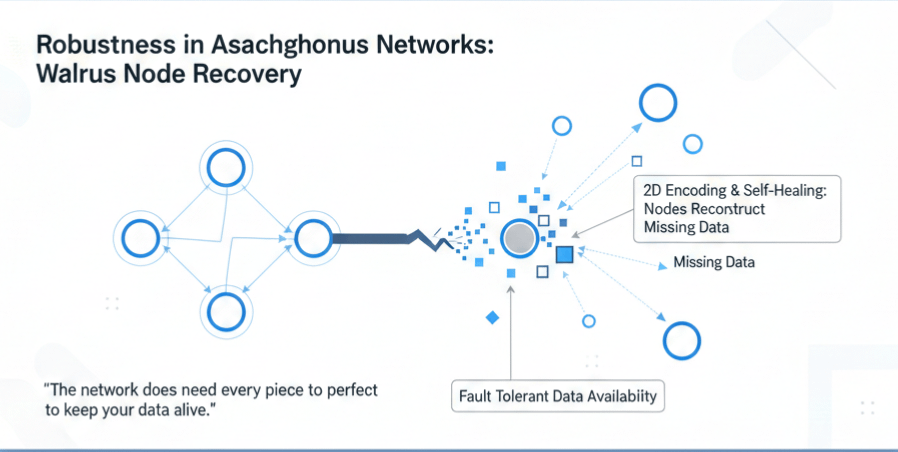
what you think about this? don't forget to comment 💭
Follow for more content 🙂