


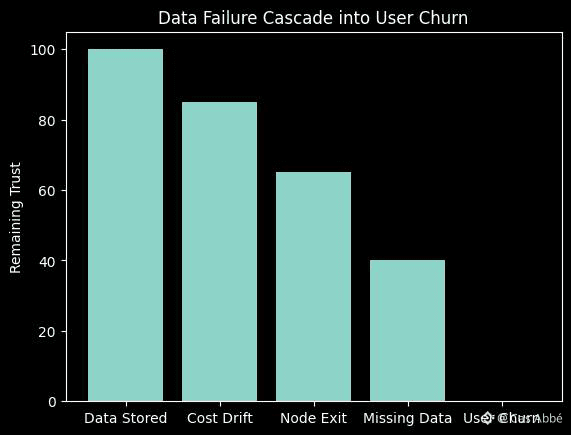
When you involve anything that real users can touch, you acquire one simple rule very quickly: people are tolerant of bugs, but intolerant of missing history. An application created as a dApp can include flawless transactions yet feel like it's broken when the charts are missing, the pictures are not loaded, the receipts cannot be obtained, or the proof link 404s. That's not a storage problem. That's a retention problem. Walrus is constructed on the basis of that failure: users do not churn because you have no blockspace, users churn because the application ceases to be reliable.
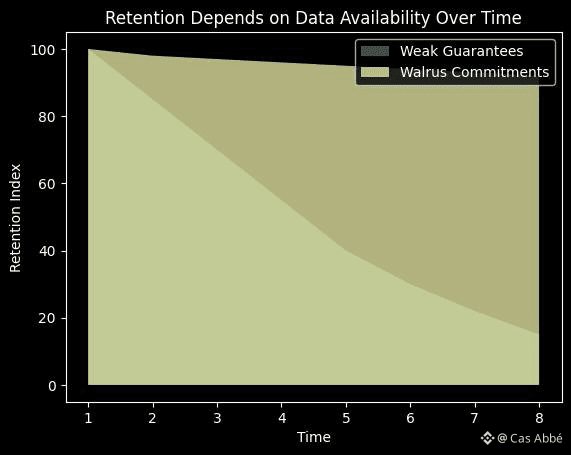
There is one design decision that Walrus does not want to make: it is not a file server of the bottom chain. Rather, it has heavy data in blobs stored in a special storage network, and uses Sui as the coordination layer that documents when Walrus officially accepts the responsibility of maintaining a blob available. Walrus refers to such moment as the Point of Availability, or PoA. Once PoA is done, the blob goes into an availability period which can be seen on Sui, that is, the commitment is not trust me but an onchain event that can be referred to by the app.
This is where most people fail, Walrus does not merely store data, but it also determines when the protocol can be considered responsible, the data. Prior to PoA it is the client that is responsible and after PoA it is the protocol. It is that border which brings a state of uploaded somewhere to the network has taken custody. Data feel permanent in real systems because of custody. And, when one has no custody, storage is but hope.
Walrus is also time specific. Storage is acquired not indefinitely, but over a finite number of epochs. On mainnet, an epoch takes two weeks, and storage can be purchased with a limit (it has 53 epochs). This is important since it makes the time-cost of duration visible, it makes the time-value of renewals visible, and the system does not conceal the long-term liabilities within the term permanent. What appears to be a constraint, is how you make infrastructure honest over years.
Now the financial aspect: PoA is not only a certification to the user, it is a beginning of long-term service to storage nodes. Walrus bonds that commitment to bonuses. There is a WAL stake requirements of nodes, and incentives are based on correct over-time behavior, not merely appearing once. The idea behind this is straightforward: ensure that it is unreasonable to providers who silently go away with the money. That is the way availability is turned into a property of alignment as opposed to goodwill.
As you consider Walrus, the feature is not storage of blobs. The characteristic of the feature is that an application can consider data availability a reliable primitive. Inspirational decentralization is not desired by apps. They desire to have less points of failure. Walrus attempts to eliminate the most widespread known or unknown failure: data exists until it no longer exists, due to some offchain dependency being changed, its policy, price, or uptime.
The importance of risk analysis in this case is that retention systems do not provide warnings. Walrus does not depend on an incentive that remains constant. When demand to store is poor or rewards are valued out of place, node participation may water out and it is thinning networks that reliability begins to become random again. Walrus also shares coordination risk with Sui since the PoA and lifecycle observability is there, in the event of degraded control plane the storage network can still live, but the guarantees are now more difficult to enforce cleanly. These risks do not make the model invalid, just state: what you should observe: node participation, renewal behavior and is PoA-based custody boring and consistent over time.
It is not the fact that people desire decentralized storage that is the real bet Walrus is making. It is that builders would prefer to prevent leaking users because of absent information. In case Walrus fulfils that pledge in time of strain, then it is invisible infrastructure. And it is invisibility which is what winning infrastructure looks like.

