
Every time you pay for something—online or in person—you trust that the payment will go through. You tap your phone. You click “Pay Now.” You send a transfer. And you expect the transaction to just work.
But behind the scenes, payments fail far more often than most people realize. A card gets declined. A transfer gets delayed. A subscription renewal doesn’t process. A crypto transaction never confirms. These moments feel small when they happen once. But across millions of users and businesses, they become a massive hidden problem.
This is the world Plasma is stepping into. Not with loud promises or flashy marketing. But with a quiet, practical mission: make digital payments stop failing.
The Problem Most People Don’t See
For customers, a failed payment is frustrating. For businesses, it’s costly. Each failure means lost sales, abandoned carts, extra support tickets, and damaged trust. Worse, many failures happen for reasons nobody on either side fully understands.
Traditional payment networks are layered with banks, processors, risk engines, and compliance systems. Each layer adds protection—but also friction. Blockchain networks removed some intermediaries, but introduced new complications: confusing wallets, gas fees, congestion, and unpredictable transaction behavior.
So despite technological progress, everyday digital payments still break. Not because money can’t move—but because the infrastructure moving it was never designed for simple, global, always-on digital commerce.
Why Blockchain Didn’t Automatically Fix Payments
Crypto promised “internet-native money.” And in many ways, it delivered. But most blockchains were designed to do many things: run applications, host tokens, execute smart contracts, support trading, governance, and experimentation.
Payments were just one use case among many.
This created problems. Fees fluctuate wildly. Sometimes sending money costs almost nothing; other times it costs too much to justify the transaction. Users need special network tokens just to pay transaction fees. Transactions can stall or fail if the network is busy. Final confirmation can take longer than a credit card authorization.
For someone trying to buy a coffee or pay an online invoice, these issues feel like a broken product. Not cutting-edge technology.
Plasma’s Different Starting Point
Plasma starts from a different question: What if a blockchain was built primarily for payments?
Not trading. Not speculation. Not complex multi-purpose computation. Just fast, reliable, low-cost stablecoin transfers at global scale.
When that becomes the starting assumption, design decisions change. Fee systems change. Asset handling changes. Performance targets change. User experience changes. Instead of forcing payment use cases into a general-purpose chain, Plasma builds the chain around payment behavior itself.
It’s not chasing hype. It’s chasing consistency.
Making Fees Boring on Purpose
In most blockchains, fees rise and fall based on demand. That makes sense for decentralized networks competing for limited block space. But for payments, it’s a nightmare. Businesses can’t predict costs. Users don’t know what to pay. Transactions get stuck. Checkouts fail.
Plasma’s approach is to keep fees stable and low. Not occasionally low. Consistently low. That predictability means a payment today behaves like a payment tomorrow, even if network activity changes.
When costs stop surprising users, payment flows become smooth. And smooth payments rarely fail.
Removing the “Gas Token” Confusion
One of the most common crypto payment failures is almost comical: a user has money, but can’t send it because they don’t have the right token to pay the network fee.
Imagine going to a store with cash and being told you also need a second special coin just to hand over your money. That’s how gas tokens feel to everyday users.
Plasma removes this barrier by letting stablecoins handle transaction costs directly. If you have money, you can move money. No extra steps. No hidden requirements. No confusing error messages.
This single change quietly removes a huge portion of real-world blockchain payment failures.
Making Settlement Feel Instant
People have short patience for payments. If a confirmation takes too long, uncertainty creeps in. Merchants hesitate. Customers refresh pages. Support lines get busy.
Plasma is built to confirm transactions quickly and consistently. Not just under perfect conditions, but under heavy usage too. When settlement becomes reliably fast, businesses can safely deliver goods, automate services, and trust the system without manual checks.
Good payment infrastructure doesn’t ask users to understand how it works. It simply works.
Reliability as a Product, Not a Feature
A surprising number of blockchain payment issues come from infrastructure instability: overloaded nodes, outdated software, unreliable network endpoints. Plasma treats operational stability as part of the payment promise itself.
Because in payments, downtime is not a technical inconvenience. It’s lost revenue and lost trust.
By focusing on maintenance discipline and network performance from the start, Plasma aims to prevent failures before users ever see them.
What Plasma Really Changes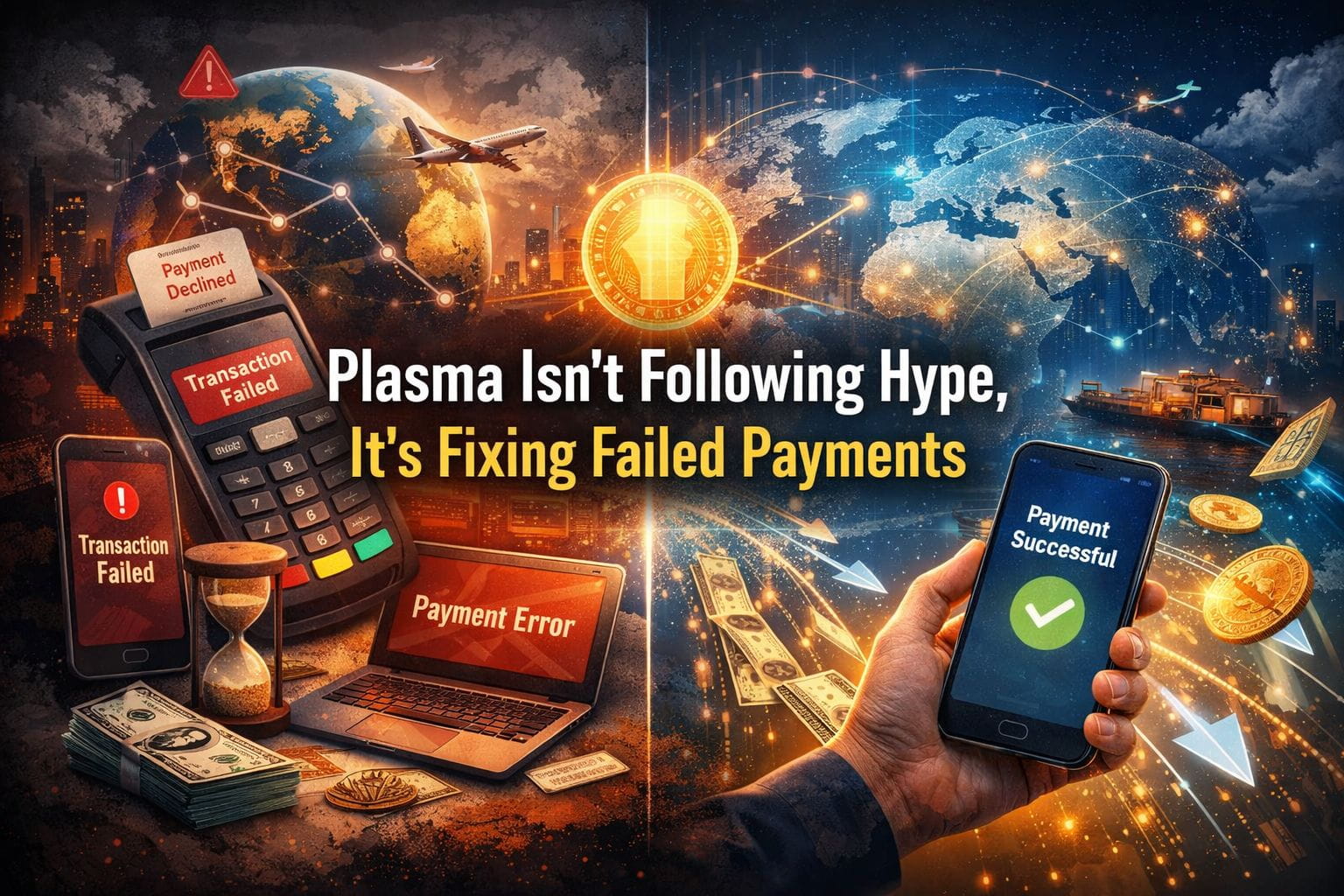
Plasma doesn’t claim to fix everything about money. It can’t create funds where none exist. It can’t bypass legal compliance. It can’t resolve human disputes.
But it can remove unnecessary technical friction: unpredictable fees, confusing wallet requirements, slow settlement, and fragile infrastructure. These are the silent causes behind most broken blockchain payment experiences today.
Fix those, and suddenly digital money starts to behave like people always expected it to.
Why This Approach Matters
The future of finance won’t be decided by the loudest project. It will be decided by the infrastructure that earns trust through reliability.
When a payment works, nobody talks about it. When it fails, everyone remembers.
Plasma is betting that the real opportunity in blockchain isn’t to build more complex systems. It’s to make a simple one that never lets payments break.
Final Thought
Plasma isn’t following hype. It’s following a real-world problem that has been hiding in plain sight for years.
If it succeeds, people won’t celebrate it with excitement. They’ll simply stop thinking about whether their payments will go through.
And in the world of money, that quiet confidence is the biggest breakthrough of all.

