


The storage systems are mostly evaluated in terms of position of data. Walrus is more to be judged by the places of rules. Walrus applies Sui as a control plane to ensure that storage is not a best-effort service; instead, it is a collection of enforceable lifecycle rules whose onchain visibility. That is why Walrus is able to discuss custody and time frames, committees, and incentives without creating a unique custom-executed chain of coordination.
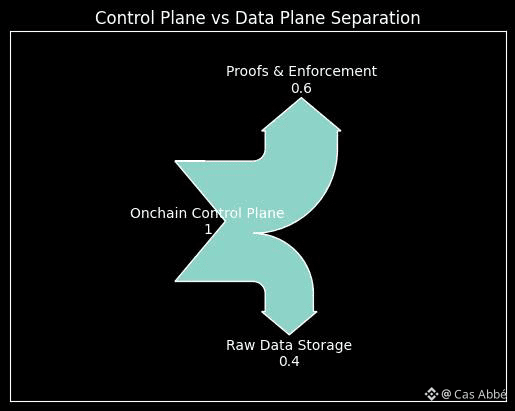
Control-plane concept comes into reality at PoA. PoA is the onchain document that storage service has started officially on a blob, and is the point at which Walrus assumes the availability responsibility. Sui events also demonstrate the availability period in that applications can make decisions based on this, instead of relying on an offchain server to manage links through blind faith. It is a nuanced change: storage is legible to contracts and apps like balances are legible.
It is this programmability that is made possible by this "legibility" that does not cause the program to bloat the chain with bytes. The heavy blob itself is done by the data plane. The commitments, timing and enforcement are controlled by the control plane. Such separation is where Walrus attempts to be applicable to the current apps and remain realistic in what blockchains are capable of and incapable of.
WAL is the economic wiring. Security is based on delegated staking: users are free to stake without operating nodes, nodes compete among themselves to stake, and stake determines which data are assigned to which node, binding security and capacity to behavior. Payments to nodes and their delegators are according to performance. To put it down in plain terms Walrus is trying to develop a feature of accountable stake in who stores what, it is not simply a matter of random promises.
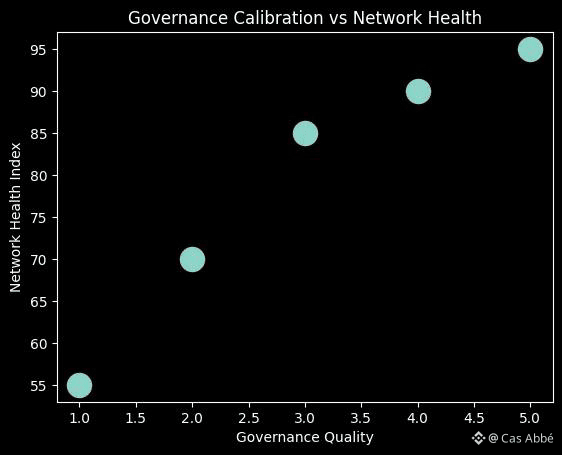
The governance problem is also brought out by Walrus. Parameters such as pricing, penalties and network calibration are not eternal truths, but rather knobs that need to be adjusted when the network evolves. The whitepaper of Mysten points out that tokenomics address the manner in which storage price and payments are processed and allocated on a per-epoch basis, and the way important parameters are governed. That is important since storage is a long-duration service, and this long-duration services are required to change without violating trust.
There are two layers of risk analysis in this case. First, there is dependence on a control plane. When there is outage or congestion of Sui, the onchain visibility and enforcement routes used by Walrus may become ineffective, although the storage nodes themselves may be online. Second, there is the slow risk of governance. Bad parameter tuning may drive providers away or render storage too costly to affordably serve teams going back to cloud. The advantage of this system is that these variables are explicit and controllable; its drawback is that explicit levers can be set so wrong.
The point of difference is that Walrus is not simply decentralized storage on Sui. It is an effort to render storage to act as a protocol-level requirement: time-constrained, verifiable, enforceable, and observable to applications. Assuming that is the case with real using, then Walrus is the type of infrastructure on which people no longer speak of as it ceases to fail. That's not a marketing win. That's an ecosystem win.


