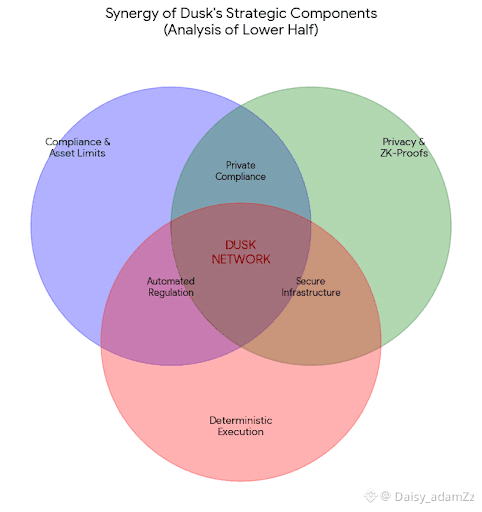
On most blockchains, rules are technically “on-chain,” but in practice they remain fragile. They are scattered across conditional statements, auxiliary contracts, front-end restrictions, and post-event governance actions. Whether those rules are actually upheld depends on developer discipline, UI correctness, and social coordination after something breaks. The protocol itself does not truly understand the rules — it merely executes instructions.
Dusk takes a fundamentally different approach.
From the ground up, Dusk treats rule enforcement as a system engineering problem, not a scripting convenience. Instead of allowing transactions to enter the pipeline and then checking compliance afterward, Dusk requires rules to be expressed as formal constraints that must be satisfied before a transaction can even be constructed. If those constraints cannot all hold at the same time, the transaction never comes into existence.
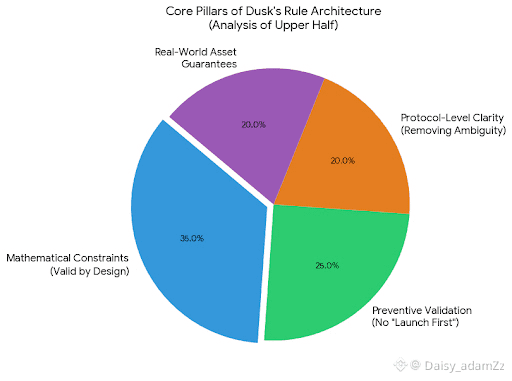
This design choice removes ambiguity at the protocol level rather than attempting to manage it later.
Why Constraint-Based Transactions Matter
Dusk does not support the mindset of “launch first, restrict later.” In its execution model, unclear or contradictory rules are not tolerated. Ambiguity is not handled through reverts, emergency governance, or patches — it is converted directly into transaction construction failure.
This is particularly important for assets that mirror real-world requirements. Regulated financial instruments, tokenized securities, and compliant payment systems do not operate on best-effort enforcement. They require guarantees.
On Dusk, rules are not optional logic branches. They are embedded into the cryptographic proof that validates a state transition. If a transaction cannot prove that it complies with all applicable rules, it is invalid by design — not by policy, not by interpretation, but by mathematics.
Rule Combinations Are the Real Challenge
The most underestimated challenge in compliant asset design is not defining individual rules, but combining them safely.
A real-world asset rarely follows a single condition. Instead, it is governed by multiple rules simultaneously:
• Lock-up periods
• Position and exposure limits
• Account eligibility requirements
• Jurisdictional restrictions
• Emergency or event-triggered pauses
• Time-based or state-based release conditions
On most blockchains, these rules are enforced independently, often across multiple smart contracts and off-chain layers. This fragmentation leads to contradictions: one contract allows a transfer, another blocks it; the UI permits an action the chain later rejects; or worse, the chain allows behavior the front-end tried to prevent.
Dusk’s architecture forces all applicable rules to be evaluated together as a single constraint system. Either every rule can be satisfied simultaneously and an executable path exists, or the transaction cannot be formed at all. Conflicts are surfaced immediately, before execution, before settlement, and before damage occurs.
What “Clear Rules” Mean on Dusk
Developing on Dusk shifts effort away from defensive programming and toward precise rule expression.
Clarity here does not mean better comments or longer documentation. It means converting human rules into machine-verifiable boundaries:
• A lock-up period becomes an explicit, readable state condition
• A position limit becomes a provable pre-state constraint
• A trading halt becomes a switch that forces state transitions to fail deterministically
If a rule exists, it is enforced automatically and consistently at the protocol level. There is no reliance on front-end behavior, manual oversight, or after-the-fact governance intervention.
This consistency is especially important in privacy-preserving systems, where enforcement must occur without exposing sensitive user data. Dusk’s zero-knowledge design allows compliance to be proven without revealing private information, aligning privacy with enforceability rather than trading one for the other.
Evaluating Dusk’s Maturity Correctly
When assessing the maturity of , the most meaningful signal is not how often compliance is mentioned, but whether rule enforcement has become a reusable engineering paradigm.
The real questions are structural:
• Can developers express rules using a standardized constraint model?
• Are rule conflicts detectable before transactions are submitted?
• Does on-chain behavior always align with declared restrictions?
• Can privacy and enforcement coexist without exceptions?
If these conditions are met, Dusk is not positioning itself as a narrative of “privacy plus compliance.” It is building a rules execution system designed for long-term operation in regulated environments.
That kind of foundation does not rely on trust, patching, or interpretation.
It relies on deterministic enforcement and cryptographic guarantees.
And that is what makes it durable.