

The current Bitcoin market is best described as a range-bound adjustment phase rather than a clear bullish or bearish trend. Directional bias remains conditionally neutral to slightly constructive, but price levels themselves are no longer the primary driver of short-term behavior. Instead, when the market moves has become more important than where it trades.
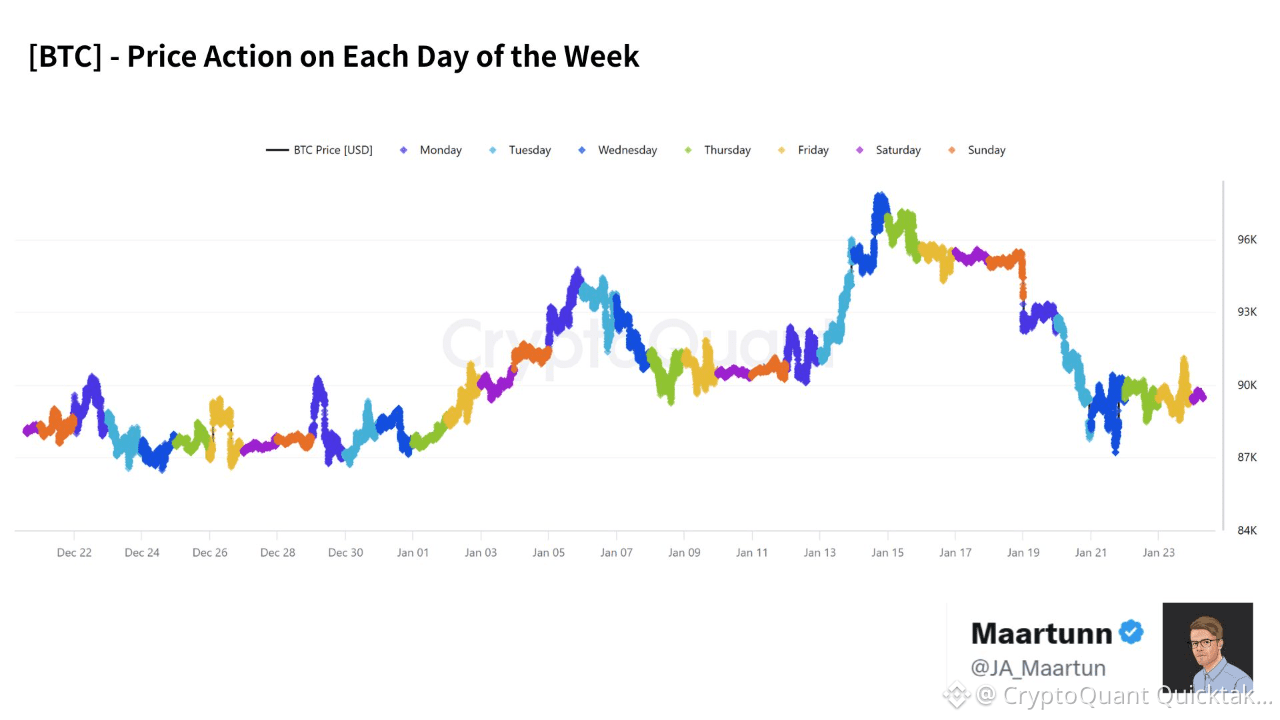
An analysis of Price Action on Each Day of the Week shows a consistent concentration of volatility during the middle of the week, particularly from Tuesday to Wednesday. During these sessions, short-term trends are more likely to form and persist. In contrast, Saturdays tend to exhibit compressed ranges and limited directional follow-through, with price oscillating within narrow bands.
This pattern reflects differences in market participant composition rather than shifts in fundamental supply and demand. On weekends, institutional traders, arbitrage desks, and macro-driven participants are largely inactive. While order books become thinner, the absence of new large flows also limits directional pressure, resulting in constrained price movement rather than instability.
On-chain data supports this interpretation. Exchange balances show no abrupt inflows or outflows, leverage remains broadly neutral, and liquidation activity is muted. Together, these signals suggest that the market is not under stress but is instead lacking the catalysts needed to break out of its current range.
The key risk to this view would be a simultaneous increase in exchange inflows and leverage expansion, even outside typical high-activity periods. Absent such signals, the base case remains a structurally range-bound market where timing, not price targets, offers the clearest insight into short-term dynamics.
Written by XWIN Research Japan